USAID DEC
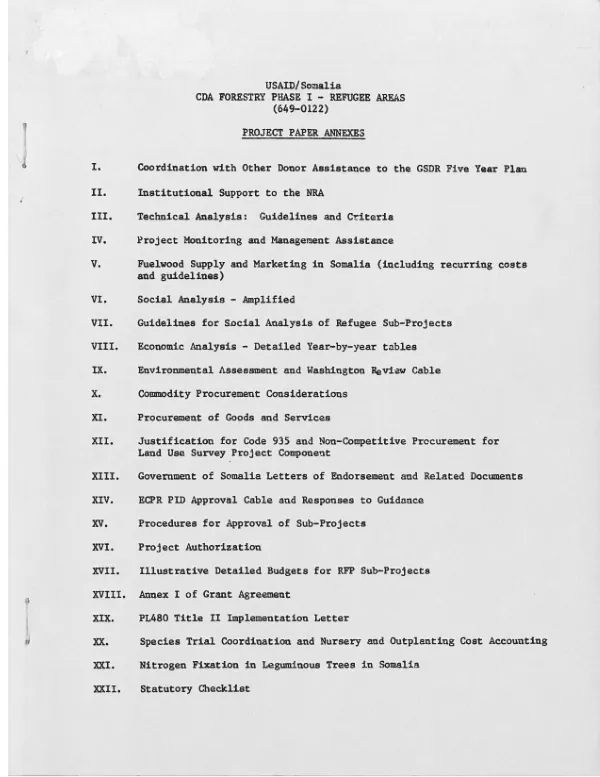
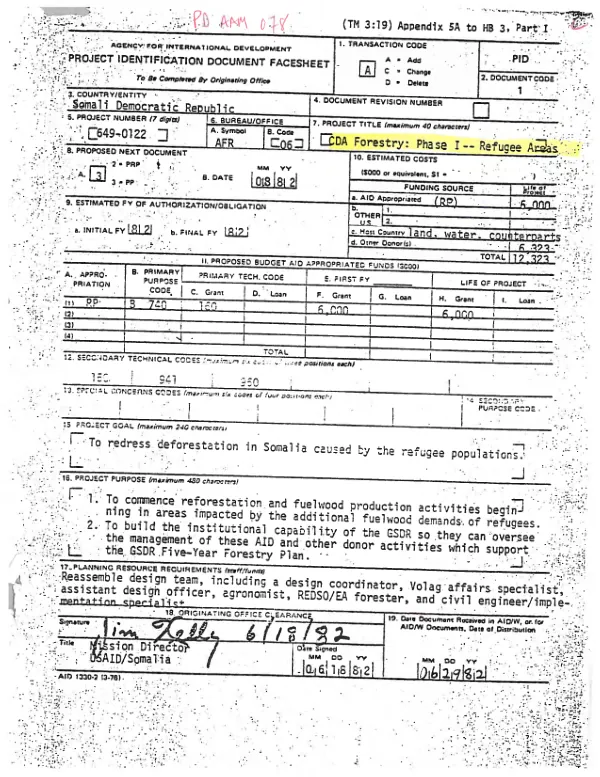
Project assistance completion report (PACR) : CDA forestry phase I, refugee areas project (649-0122)
Sign inUSAID. MISSION TO SOMALIA
Project assistance completion report (PACR) : CDA forestry phase I, refugee areas project (649-0122)
PACR of a project (11/82-1/89) to promote reforestation and fuelwood production in and near refugee camps in Somalia.
1989
Sign in to readA free account is required to download.
Abstract
The project was implemented by five PVO"s. The project was implemented according to design, and although it did not meet all quantitative targets, it succeeded in greatly increasing awareness of forestry activities among government agencies, potential donors, and beneficiaries. Training of refugees in shade tree plantings was very successful, as seen in a 90% survival rate for amenity plantings; the project demonstrated the value of trees to refugees and provided them needed employment as nursery and plantation workers. Extension activities in agroforestry were well received by farmers, and some 237 km of shelterbelts were planted; the introduction of live fencing in Somalia was an important contribution. Efforts in sand dune fixation were important also, not only as a start in controlling the dunes, but also as an experiment in methods to do so. Also, despite some deficiencies, the resource/land use survey contributed much valuable data. Fuelwood conservation was generally successful. The fencing of fuelwood plantations allowed considerable recovery of natural vegetation (particularly grass and herb cover), leading to the sale of controlled quantities of fodder from within fenced areas. Also, the project designed a 20% more efficient woodstove, though it is not selling well due to its high price. On the negative side, large-scale woodlots and block and strip plantings on public land were unsuccessful due to the harsh climate, degraded soil, poor species selection, poor government management, and the uncertainty of woodlot ownership. However, plantations of the correct species in such sites have grown well and have helped prevent further land degradation. Efforts to strengthen the National Range Agency (NRA) were a partial success. Initial training of junior and forestry technical officers at the Afgoi Forestry and Wildlife Training Center proved useful, and on-the-job training and a study tour organized by PVO"s for junior and mid-level staff were very successful. However, the effects of these efforts were constrained by low salaries, lack of incentives, and poor job performance. Several lessons were learned. (1) Local circumstances (e.g., climate and land tenure systems) must be integrated into project design. Attention to these conditions can make forestry/fuelwood projects succeed even in a relatively arid climate. (2) Sufficient time must be programmed to achieve desired results. In arid regions with a short planting season, 36 months is insufficient for incorporating even initial findings into improved procedures. (3) Sustainability must never be lost sight of. In this case, improved seeds were not available after the project terminated. (5) Expatriate staff must have relevant experience, as many technical advisors did not have appropriate background in dryland/arid zone forestry management.
![CDA forestry [phase I refugee areas project]](https://covers.devme.ai/gen/72447.webp)