USAID DEC
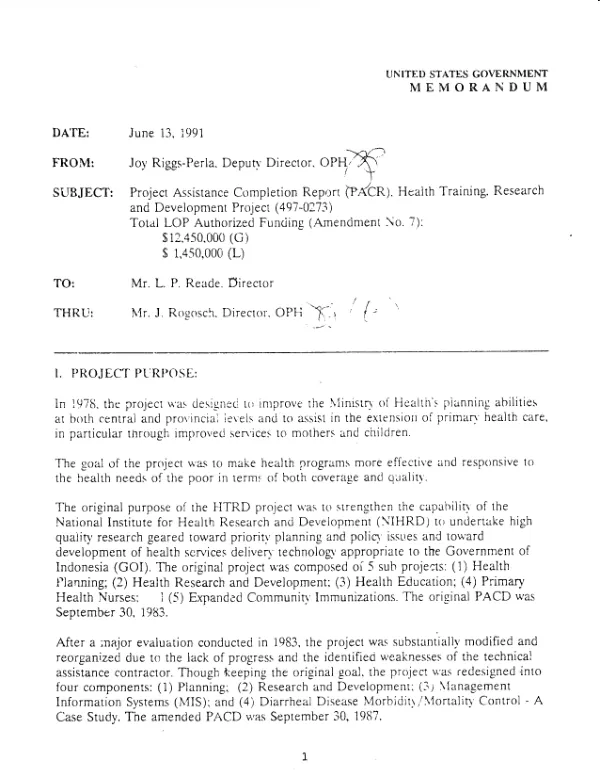
Project assistance completion report (PACR) : health training, research and development project (497-0273)
Sign inUSAID. MISSION TO INDONESIA
Project assistance completion report (PACR) : health training, research and development project (497-0273)
PACR of a project (1978-1990) to strengthen the capability of Indonesia's Ministry of Health (MOH) to improve health planning and expand primary health care.
1991
Sign in to readA free account is required to download.
Abstract
The project was substantially modified in 1983 due to a lack of progress. The redesigned project had four components: planning, research and development, management information systems, and diarrheal disease morbidity/mortality control. The PACR focuses on the 1983-1990 period. Major accomplishments include the following. (1) The project demonstrated how the MOH could work with private sector advertising firms to generate new demand for oral rehydration salts (ORS) among rural mothers. Private firms have also expressed an interest in sponsoring radio and TV time for public service messages due, in part, to project activities. (2) A post-intervention knowledge, attitudes, and practices survey in the pilot province of West Java indicated that a mass media campaign to improve mothers' knowledge and use of oral rehydration therapy had a significant impact. (3) Diarrheal disease counseling cards developed in West Java were useful tools for volunteer workers in guiding and counseling mothers during village health post meetings. (4) The project established diarrhea training units in three provinces and provided training to staff. (5) About 18,000 nurses and midwives were trained in diarrheal disease case management along with physicians. Following training, they were placed in areas where physician coverage was low. (6) The medical education curriculum for diarrheal disease was revised in eight national universities. (7) Large social marketing communications projects were conducted in three provinces, utilizing the following media: TV and radio, banners, plastic store bags, flyers, calendars, billboards, newspaper adds, and mobile village videos. Despite these achievements, ORS supply remains poor at the community level and drop-out or inactive rates for village health workers are high (more than half). In addition, financial management was often substandard, contributing to implementation delays. Three major lessons were learned. (1) The project demonstrated an effective approach to training village health workers and it is evident that these cadres will be necessary until the government health system is expanded to every community. (2) The selection process for village health workers should be re- examined to decrease the drop-out rate. (3) Further efforts need to be made to explore fully commercial sector interest in marketing ORS products.
Related documents
![Report of the child survival X project [Ecuador] : final evaluation](https://covers.devme.ai/gen/53377.webp)
![Final evaluation : ADRA [Adventist Development and Relief Agency]/Rwanda -- child survival project : 1985-1989](https://covers.devme.ai/gen/6085.webp)
![Report of the child survival X project [Ecuador] : final evaluation](https://covers.devme.ai/gen/5784.webp)