USAID. MISSION TO INDONESIA
Expanded program on immunization
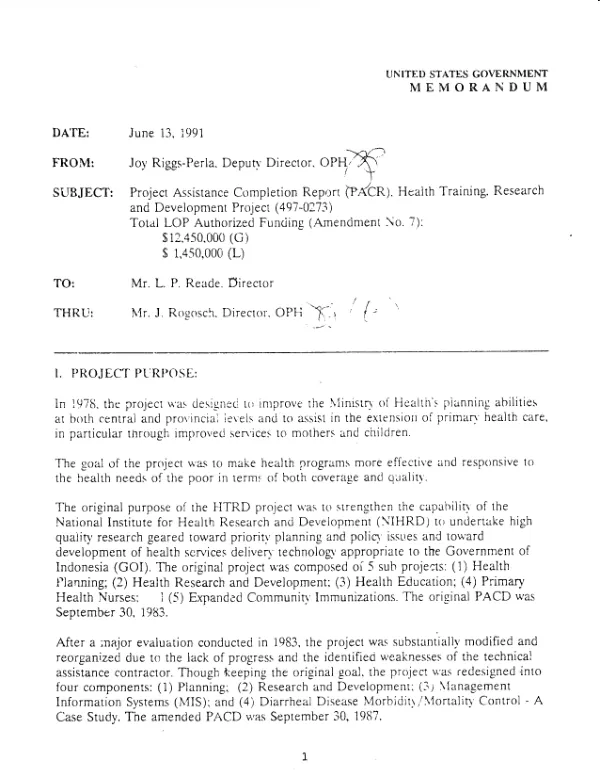
Summarizes attached evaluation of Indonesia"s Expanded Program on Immunization (EPI) and Control of Diarrheal Disease Program (CDD).
1987
Sign in to readA free account is required to download.
Abstract
Joint WHO/UNICEF/A.I.D. evaluation (sponsored by WHO) covered the periods 1977-12/86 and 1981-12/86, respectively, and was based on interviews at health facilities, government offices, and households in six provinces. Since EPI was last assessed in 1982, the program has increased both the types of vaccines it offers as well as its geographical coverage - immunizations are now being provided in 90% of the country"s subdistricts. EPI seems to be having a positive impact on the incidence of targeted diseases. The remaining problems include: only 22% of pregnant women have received two doses of tetanus toxoid; measles immunization is still disappointingly low; and there are many missed opportunities for immunizing women and children. As for CDD, 77% of the mothers interviewed recognized an Oralit packet as being used in the treatment of diarrhea, and of these, 55% could prepare Oralit correctly. Oral rehydration salts were available at almost all health facilities, pharmacies, and drug sellers visited. The major problems remaining are inadequate priority given to the importance of diarrheal diseases as a national problem, low knowledge of the standard treatment plans for diarrhea, and an inadequate reporting system. Major recommendations include: (1) while mothers and children are waiting at health facilities to see a doctor, staff should review growth charts, mothers" knowledge of diarrhea management, and the immunization status of both mothers and children; (2) training should be increased, including basic training in monitoring local disease trends; (3) sentinel surveillance systems should be strengthened; (4) adequate supervision should be stressed at all levels; (5) geographical expansion of the programs should be carefully guided; and (6) a systematic approach should be taken to health education and information activities. Action decisions are provided on EPI, including to: develop strategies to reduce missed immunization opportunities and reduce drop-out rates; improve the Ministry of Health"s (MOH) capacity to decentralize EPI planning and management; and enhance sustainability by increasing host government budgetary commitments and improving self-sufficiency in vaccine procurement. A project paper amendment addresses these issues in detail. (Author abstract, modified)
Related documents
Documents in this collection
 1991
1991USAID DEC
African child survival initiative : combatting childhood communicable diseases (regional components)
Open record 1986
1986USAID DEC
![[Development Fund for Africa --] impact of child survival activities in Africa : a report on AID's progress in reducing infant and child mortality and illness in 17 child survival priority countries](https://covers.devme.ai/gen/8905.webp)