USAID. BUR. FOR RESEARCH AND DEVELOPMENT. OFC. OF ENERGY AND INFRASTRUCTURE
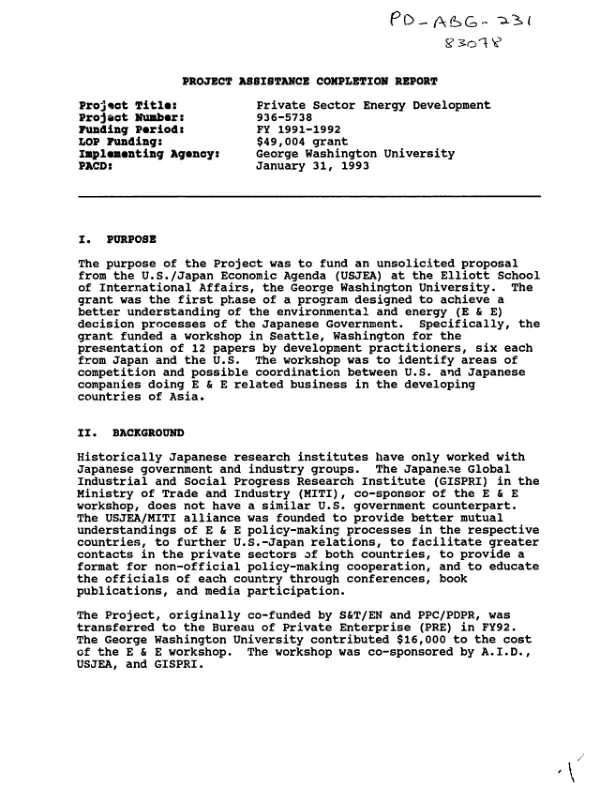
Project assistance completion report : private sector energy development
PACR of a project activity to identify, through a workshop, areas of competition and possible coordination between U.S.
1993
Sign in to readA free account is required to download.
Abstract
and Japanese companies doing environmental and energy (E & E) related business in Asia. Sixteen U.S. and ten Japanese development practitioners participated in the workshop, which was held in 9/92 in Seattle, Washington. Although the Project was initially to generate 12 papers, 6 each from Japanese and U.S. development practitioners, 10 papers were actually presented at the workshop, 5 from each country. Workshop participants visited the Weyerhaeuser Corporation's Rochester Forest Regeneration project. No immediate developmental impact was derived from the project. Lessons learned are: (1) Nongovernmental and noncorporate entities are best suited for environment projects because there are no direct political or economic interests involved. Additionally, NGOs and other nonprofits are more likely to realize the "plus sum" outcomes of E & E programs. (2) Commercial competition between Japan and the U.S. has reduced cooperation for E & E programs in developing countries. (3) U.S. NGOs should be encouraged by A.I.D. to implement joint energy and environmental studies and activities with counterparts in developing Asian countries. (4) U.S.-funded NGOs should be encouraged to work with Japanese-funded NGOs to influence Japanese government policy making. (5) E & E projects that are jointly and multilaterally funded should be developed because this will promote international contract completion. (6) Japan budget surpluses and clean air technology expertise should be combined with the positive image the U.S. has earned for delivering technical assistance to implement E & E projects in developing countries.
![Final report : evaluation of WEC's [World Environment Center's] activities under the US-AEP [Asian Environmental Partnership] cooperative agreement](https://covers.devme.ai/gen/7359.webp)