USAID. BUR. FOR LATIN AMERICA AND THE CARIBBEAN. REGIONAL DEVELOPMENT OFC.
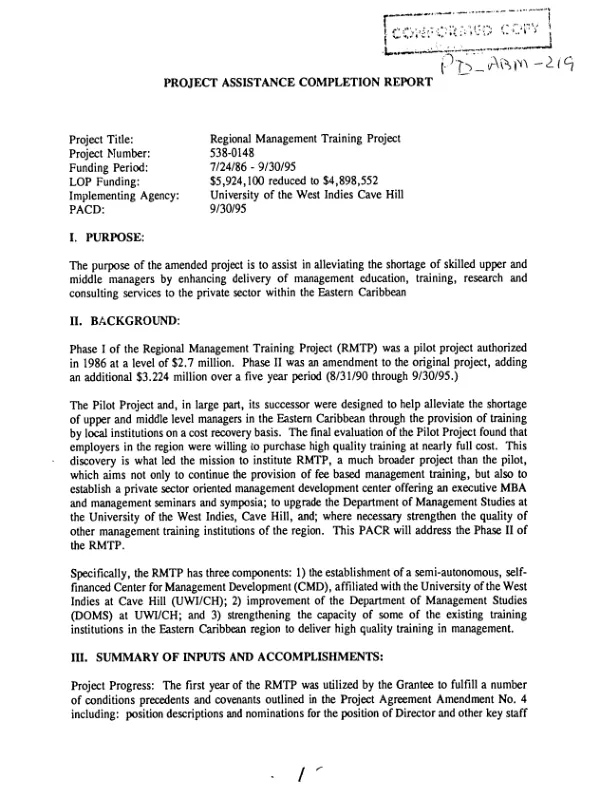
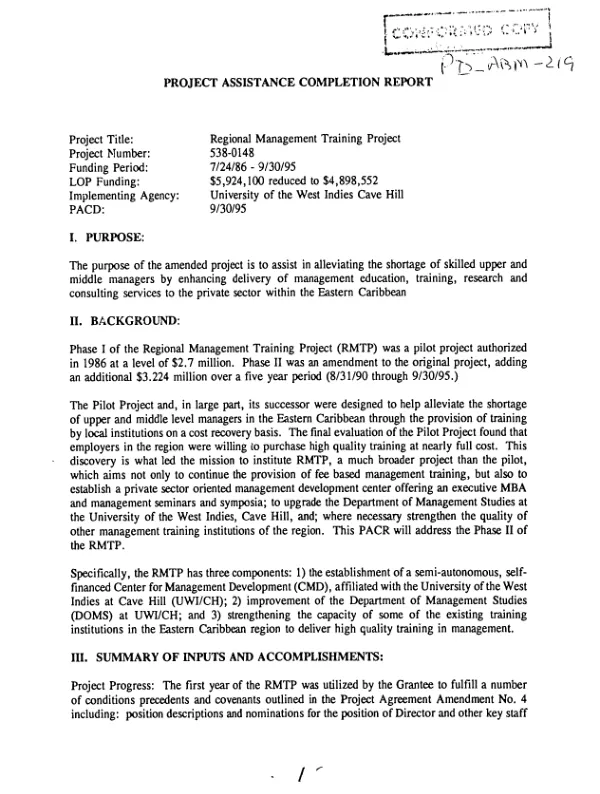
Project assistance completion report : regional management training project
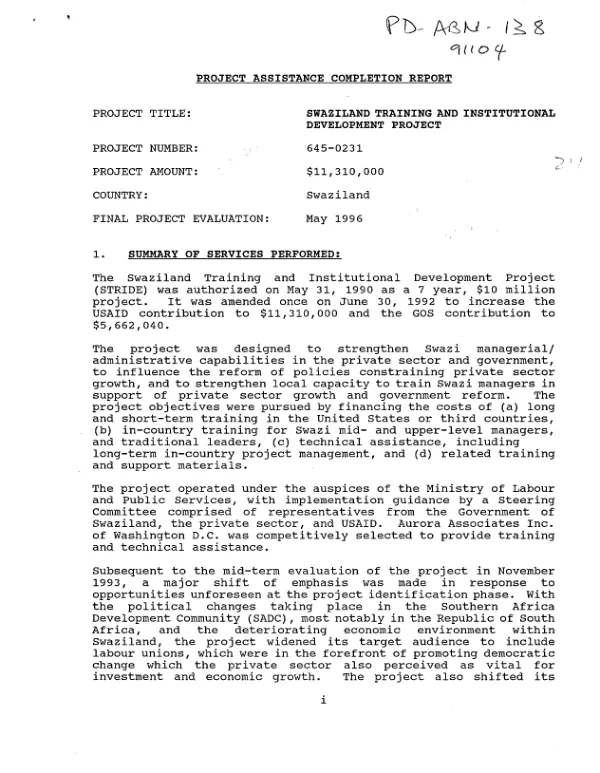
PACR of a project (7/86-9/95) to improve the delivery of management education, training, research, and consulting services to the private sector in the Eastern Caribbean, where there is a shortage of skilled upper and middle managers.
1995
Sign in to readA free account is required to download.
Abstract
The project was implemented by the Department of Management Studies (DOMS) of the University of the West Indies, Cave Hill (UWI/CH), and by the Center for Management Development (CMD), a self-financed UWI/CH affiliate. According to the 8/93 mid-term evaluation, the project's delayed start-up was due to management problems, including the multi-nationality of the CMD. In response, the project restructured and revised job descriptions at the CMD and appointed an overall Project Coordinator for UWI. USAID, however, found the CMD restructuring unsatisfactory and withdrew support for CMD's operating costs in 12/93, authorizing use of the Pilot Project Participant Fees account for this purpose. On the positive side, the new UWI director accelerated project implementation. The CMD, established in 1991 with a small core staff led by an Executive Director, launched the Executive MBA (EMBA) program in 1992 (for which a total of 148 students have registered) and will launch the Graduate Diploma in the Human Resource Management Program in 2/96. CMD also: conducted two case writing workshops and two training of trainers workshops; designed over 100 Caribbean cases; published two text books and edited several seminar presentations; conducted a range of Executive Development Programs; administered a Certification Course in Business Administration for the St. Lucia Government; and launched an extensive 6-month reclassification certificate program for 40 public servants in St. Lucia. In addition, several seminars/symposia and workshops were held, and 7 satellite training sites in the Eastern Caribbean were established. Institution-building efforts directed at the DOMS achieved some measure of success, especially after the mid-term evaluation. Two DOMS members earned Masters of Business Administration (MBA) Degrees, at Florida International and Boston University respectively, and all DOMS members took advantage of local or U.S. short-term training. In addition, the DOMS acquired a modern audiovisual, library, and computing equipment and supplies; computers for its computer laboratory and offices; and a CD-ROM library facility. Finally, the Department was provided with teaching manuals and with TA in faculty performance appraisal. The project will have its greatest impact in four areas. (1) The EMBA program is attracting both public and private sector students from Organization of Eastern Caribbean States (OECS) countries, Barbados, and, more recently, Jamaica and Trinidad. EMBA students and graduates are already making an impact in terms of new ideas in business and public administration, and the potential for widespread impact throughout the region is vast. The Government of St. Lucia in particular has sponsored a large number of its employees for the program. (2) The satellite training centers, though they were established late in the project, provide the potential for extending the training programs to the smaller OECS countries, augmenting CMD offerings, and increasing the potential intake into the EMBA program. (3) A functioning, well-managed, and self-financing CMD capable of meeting the need for non-EMBA training in the region is now a reality. (4) UWI's failure to nominate 6 candidates from the DOMS for long-term training was a disappointment not wholly compensated for by the short-term training provided under the project. The following lessons were learned. (1) Perseverance has its rewards. Despite the myriad problems USAID had with the grantee not meeting project conditions and covenants, not adhering to the implementation plan and project outputs, and in overall management, it became apparent in the project's final 6 months and with the appointment of a new CEO that overall project objectives will be achieved. (2) Avoid too many project agreement conditions and covenants. The grant agreement appears to have been over-conditioned and -covenanted due to failure to achieve consensus with the grantee beforehand; perhaps the rush to obligate funds led to this. What resulted was a series of unrealistic deadlines which USAID continually had to extend and which were fulfilled, if at all, in form rather than in substance. It is better to delay project obligation until things are truly agreed upon with "the customer." (3) Although the project design was considered adequate, for some reason the project did not gel until an overall project director was appointed, at which point a difference could be felt in the grantee's responsiveness to USAID.
![Final evaluation report on project number 538-0014 -- OECS [Organization of the Eastern Caribbean States]](https://covers.devme.ai/gen/6899.webp)