USAID DEC
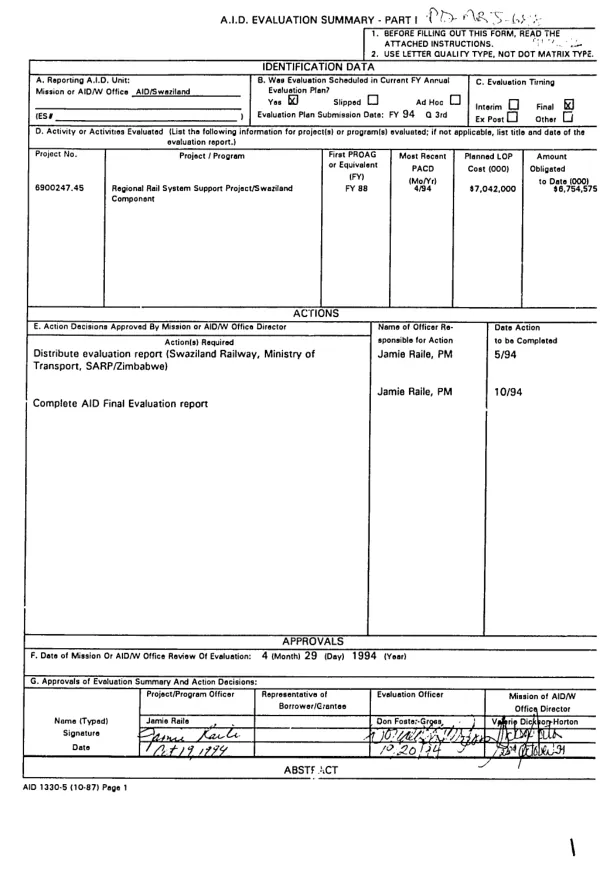
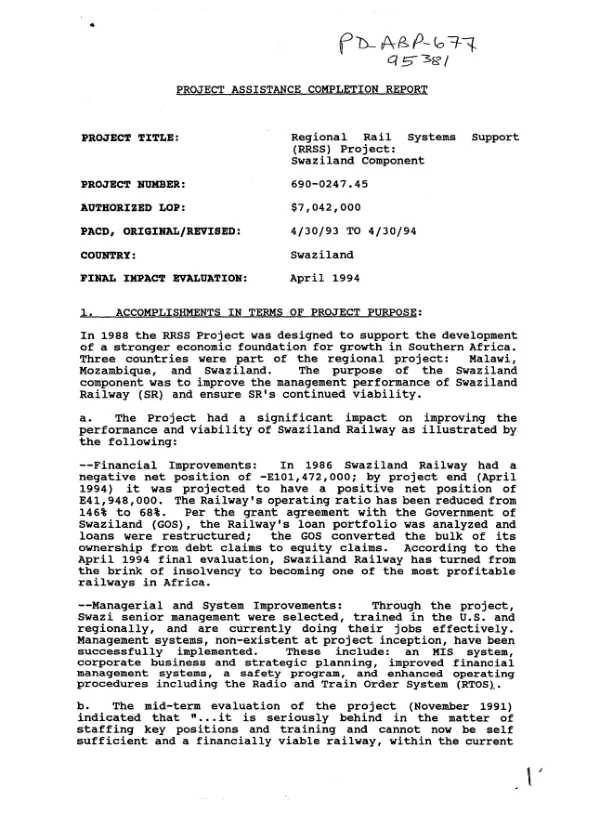
Project assistance completion report : regional rail systems support (RRSS) project, Swaziland component
Sign inUSAID. MISSION TO MOZAMBIQUE
Project assistance completion report : regional rail systems support (RRSS) project, Swaziland component
PACR of a Swaziland subproject (1988-4/94) of the Regional Rail Systems Support Project in Southern Africa.
1994
Sign in to readA free account is required to download.
Abstract
The purpose of the subproject was to improve the management performance of Swaziland Railway (SR) and ensure its viability. Despite the gloomy predictions of the 11/91 mid-term evaluation, the subproject has had a significant impact on improving the performance and viability of SR. Its net financial position, which stood at negative E10l,472,000 in 1986, improved to positive E41,948,000 by 4/94, and its operating ratio has been reduced from 146% to 68%. Per the grant agreement with the Government of Swaziland (GOS), SR's loan portfolio was analyzed and loans were restructured; the GOS converted the bulk of its ownership from debt claims to equity claims. According to the 4/94 final evaluation, SR has turned from the brink of insolvency to becoming one of the most profitable railways in Africa. Swazi senior management were trained in the United States and regionally and are doing their jobs effectively. Other training included on-the-job training and regional courses and technical training for SR managers and other staff. Additionally, management systems, non-existent at project inception, have been successfully implemented. These include: a management information system, corporate business and strategic planning, improved financial management systems, a safety program, and enhanced operating procedures, including the Radio and Train Order system (RTOS). Assessing the project's impact on regional economic growth is more difficult. However, at its peak in 1991, over 4 million tons of transit traffic went through Swaziland; substantially more traffic is moved by SR than other railways in the region (Tanzania, Zambia, Mozambique). The railway has provided a shorter and cheaper route for transit traffic moving between the South African ports of Durban and Richard's Bay, and Northern Transvaal and Zimbabwe, Malawi, and Zambia. The following lessons were learned. (1) Management transitions can be successful if all parties are committed to the effort. In this project, expatriate contractors moved from management positions to advisory positions after Swazi management training was completed, and then left at the end of the contract. (2) When planning to transfer management responsibilities from the contractor to a local institution, the latter's Board of Directors' roles and abilities should be assessed. Any efforts to strengthen the institution should begin at the project start-up. Although this was not part of the original project design, work was instigated with the railway board during the last year of the project when it became apparent that their skills would need to be strengthened. (3) When designing regional projects, it should be remembered that not all project components may offer a win-win situation for each country. One of the output targets for this project was an increase in intra-SADCC (Southern Africa Development Coordination Conference) traffic on SR. With the changed political conditions in South Africa, and with improved security and railway conditions in the region (especially Mozambique), less transport traffic is expected to flow through Swaziland in the future (although other countries will benefit by using more economical and shorter routes).