USAID. MISSION TO SWAZILAND
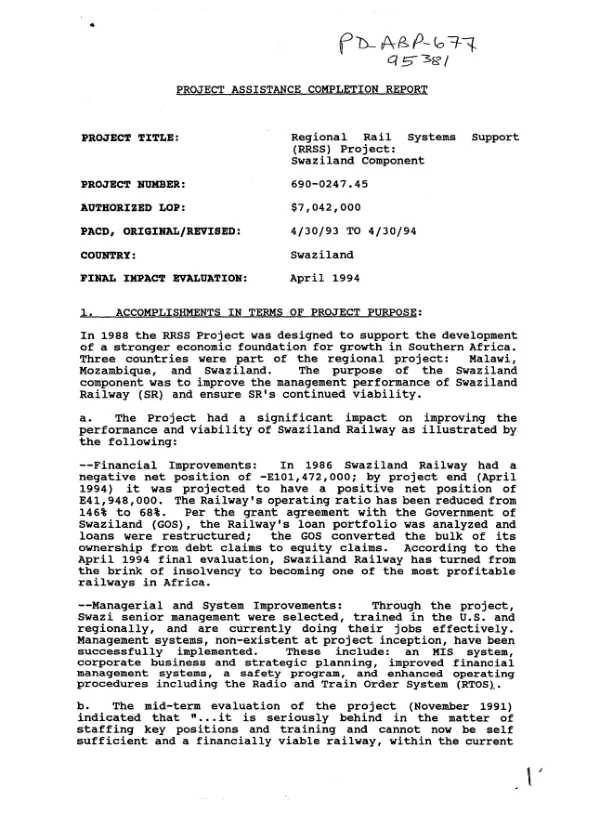
Regional rail system support project/Swaziland component
Summarizes final evaluation (XD-ABJ-688-A) of a project (1989-94) to improve the management capacity of Swaziland Railway (SR) through a program of training and TA.
1994
Sign in to readA free account is required to download.
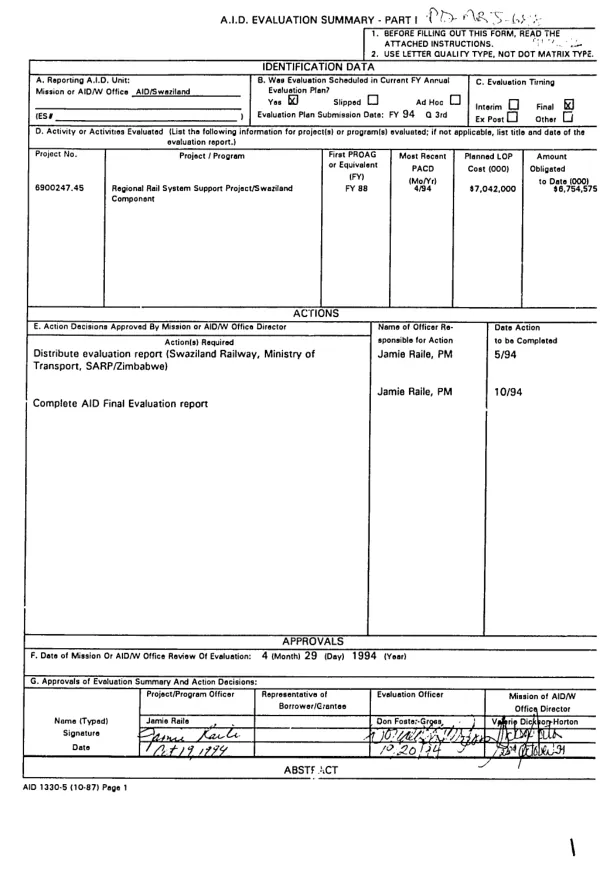
Abstract
As a result of the project, SR is financially viable and should remain so in the foreseeable future. Through the efforts of SR management and staff, USAID leadership, and the support of the Ministry of Transport and Communications, it was brought from the brink of insolvency to being one of the most profitable railways in Africa. Project achievements include the following. (1) SR"s net position now stands at plus E41.948 million compared with minus E101.472 million in 1986. (2) The Senior Management Training Program has been completed and, except for the Chief Engineer, the SR management team is in place and operating the railway. (3) SR"s operating ratio was reduced from 146% to 83.3% vs a target of 68%; the projected ratio for FY95 is 77.8%. (4) Coordination of train movement through the Radio Train Order System and enhanced operating procedures have been established through effective planning and training. The use of SPRINT for wagon information requirements is insufficient, however, and the current processes are overly dependent on the Director of Traffic"s daily interventions. (5) As planned, SR"s"s financial and capital structure have been analyzed, changes recommended, and action plans adopted. SR"s financial structure has been improved by discontinuing steam locomotive operations, assessing and separating excess employees, and negotiating business agreements with major suppliers. SR"s"s capital structure is now manageable. (6) As planned, the loan portfolio has been analyzed and loans have been restructured. The Government of Swaziland has restructured the bulk of its ownership from debt claims to equity by converting infrastructure loans into equity and natural disaster loans into grants. In addition, SR"s has retired high interest rate commercial debt obligations and eliminated foreign exchange losses. Finalization of servicing plans for remaining debt obligations is in progress. (7) Business planning responsibilities have been entrusted to a newly hired manager of market research. (8) Notable progress was made in determining SR"s"s legal rights under the SR"s/SATS (South Africa Transportation System) Memorandum of Understanding, which has been established as legally binding and applicable to SPOORNET (South Africa Railways). This should strengthen SR"s"s negotiating position. (9) Considerable progress has been made in establishing an SR management information system, and the Radio Train Order System has dramatically improved the currency, accuracy, and value of operating information flows. Work is still needed to standardize software systems, improve information transfer among departments, and develop wagon control and freight accounting. (10) Considerable progress has also been made in revising SR"s tariff structure, and a cost-based tariff has been implemented. A simple computer program was developed for determining costs by commodity and route. Emphasis can now be placed on perfecting data inputs into the model and on calculating tariffs that will maximize revenue while remaining competitive. (11) Development of an improved financial management system was partially completed. In other areas, the project helped SR to develop marketing plans; trained 31 senior SR officers, most of whom have returned to SR; and improved SR"s institutional capabilities through substantial on-the-job training and development of an excellent staff training plan (although the manager trained to implement the plan left). The following lessons have been learned. (1) The project"s training format should be a model for future USAID programs. (2) Successful transition to local management can occur if all parties, including the Board of Directors, are committed to the effort.