USAID DEC
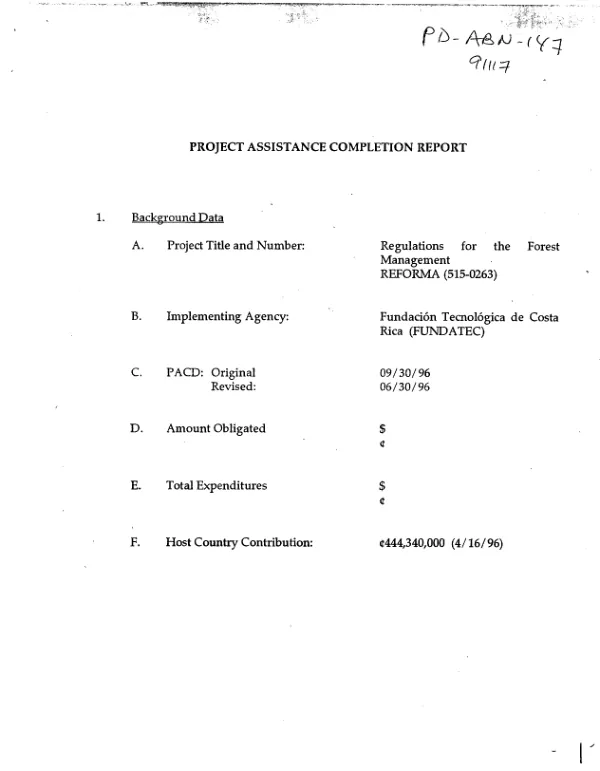
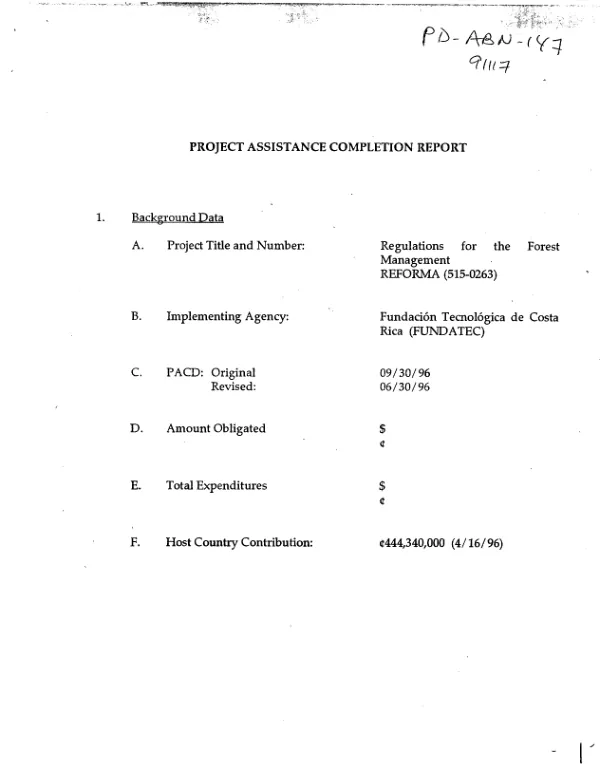
Project assistance completion report : regulations for the forest management (REFORMA) (515-0263)
Sign inUSAID. MISSION TO COSTA RICA
Project assistance completion report : regulations for the forest management (REFORMA) (515-0263)
PACR of a project (8/93-6/96) to promote sustainable forest management in Costa Rica (REFORMA project).
1996
Sign in to readA free account is required to download.
Abstract
Several positive results were achieved by this ambitious project. Its key accomplishment, according to the seven participating organizations, is that now they understand much more clearly what they must do in the future -- and the disaster that will result if they fail. REFORMA increased public awareness of the importance of the forest and the possibility of a higher standard of living for farmers and landowners; successfully and fruitfully brought together government personnel, scientists, technicians, conservationists, community leaders, and business people to discuss the state of the country's forests, exchange experiences, and coordinate their efforts to save remaining forest resources; and put NGOs, the private sector, and the State to work on the same objective -- to find solutions to deforestation threats. The project made possible the extremely useful monitoring of allegations of illegal logging by CEDARENA (unidentified acronym), while CIIBI (unidentified acronym) produced maps of the forest cover. These achievements will enable MINAE (probably the Ministry of Natural Resources) to control deforestation more efficiently and develop a sector strategy. A key achievement was the reconciliation between forestry officials and members of the legal system through training courses where they exchanged ideas, experiences, criticisms, and expectations. Also, project support for Camara Costarricense Forestal (CCF) as lead entity for the private sector fostered a joint effort to ensure that the new forestry law incorporated regulations important to the interests of the forestry sector. The CCF improved relationships with the government, simplified procedures, and launched various programs with the forestry sector that put the sector on the road to sustainability, such as the National Program CCF Genetic Improvement of Seeds for Reforestation. Following are the major lessons and conclusions. (1) The project's brief year and a half duration, aggravated by a slow start and an abrupt finish due to forces outside its control, is not enough time to see concrete results. Yet several positive outputs were obtained. (2) Current policies, systems, and procedures, together with existing economic, social, and political factors, will result in continued deforestation and a fragmented forest production base. The remaining forest cover will be composed of small forest islands incapable of supporting a forest industry. Most local foresters predict this will have major negative economic and environmental effects. Through project activities and accomplishments, the Ministry of Natural Resources received a clear message that it must concentrate its efforts on the remaining core area of standing productive forests, reconfigure its staff and material resources accordingly, and identify the additional resources needed to function effectively. (3) The forest industry's general opinion is that much remains to be done. Among other things, it is necessary to develop an adequate forestry incentives and to support effective control of deforestation with sustainable yield. (4) Education and training cause a change in mentality for the long term, but in the short term it is necessary to work harder on preventing illegal deforestation. It is also important to start using approved forestry management plans and create a market mentality among both farmers and the forest industry. (5) Integration of different sectors is vital for coordinatation of resource preservation and adequate management. A multidisciplinary group composed of MINAE, the industry, universities, the media, loggers, sawyers, and equipment operators needs to be formed to exchange information, coordinate field work, and attain forest management that is both truly scientific and economic.