USAID. MISSION TO COSTA RICA
Regulation for forest management
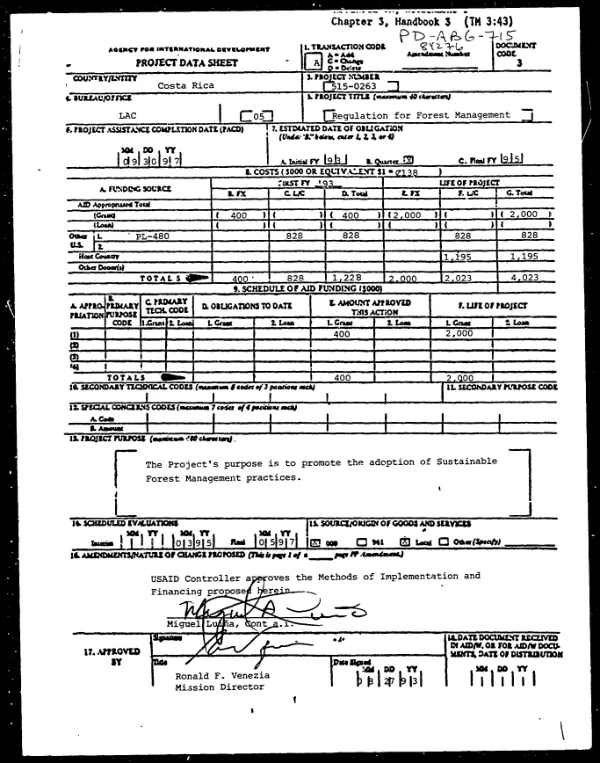
Project to promote sustainable forest management practices in Costa Rica by developing appropriate forestry regulations, strengthening government capacity to enforce these regulations, and enlisting public support for regulation.
1993
Sign in to readA free account is required to download.
Abstract
The Directorate General of Forestry (DGF) and the Ministry of Natural Resources, Energy and Mines (MIRENEM) will be the primary implementing agencies. To help the Government of Costa Rica (GOCR) to develop simplified, enforceable forestry regulations, a permanent forestry review committee representing the DGF, private foresters, and academia will be appointed to design mechanisms for public review of DGF"s forest management plans. In addition, Centro de Investigacion en Integracion Bosque Industria (part of the Costa Rican Institute of Technology) will conduct operational research to develop standardized procedures and computer-based analytical tools for national-level forest management planning. Policy research will identify forest product trade policies that would encourage sustainable forest management. The project"s second component will help to ensure there are sufficient resources to enforce the improved regulatory program. The GOCR will increase deployment of DGF personnel and material and logistic resources in three pilot areas -- La Curena in the Northern zone, the Osa Peninsula in the Southern zone, and the Talamanca in the Atlantic zone -- which include 60-70% of the country"s remaining relatively undisturbed primary forest area outside of the protected area system. These personnel will be provided with sufficient amenities, such as housing, and adequate equipment to promote higher morale and enforcement effectiveness. A computerized inventory and monitoring system will be developed for use at road checkpoints to verify that log trucks contain only legally cut timber; the system, which will include information on the number of forestry permits issued, volume harvested, and timing of logging activities, etc., will also be also be available to support the DGF"s regional and national planning. This component will also support training and continuing education of judges, prosecutors, DGF staff, local police, and concerned citizens in forestry jurisprudence and the monitoring of court cases involving infractions of the forest law. The third component will strengthen understanding of and support for the new regulations. Two training programs in sustainable forestry will be developed -- one for DGF and private sector foresters at the supervisory level, and a practical field instruction program for tree fellers, machinery operators, and DGF inspectors. In addition, a local NGO will conduct a public information campaign, reporting on forestry regulations and enforcement activities and sustainable forestry practices. Modest support will be provided to other local NGOs and private associations to strengthen their capacity to promote sustainable forestry practices in the three pilot areas. Finally, the project will fund studies and activities to support new markets and trade opportunities for Costa Rica"s forest products, including the creation of a forest products trade support office within an NGO representing the forest sector.