USAID DEC
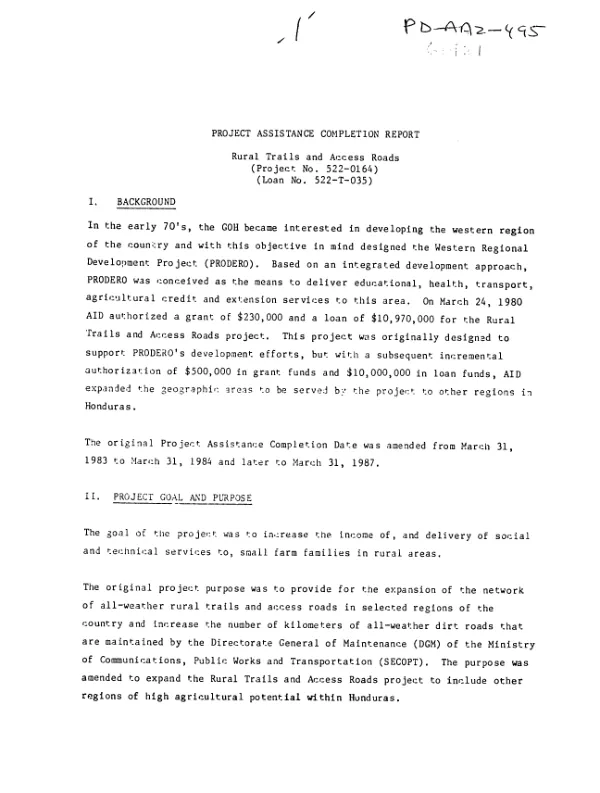
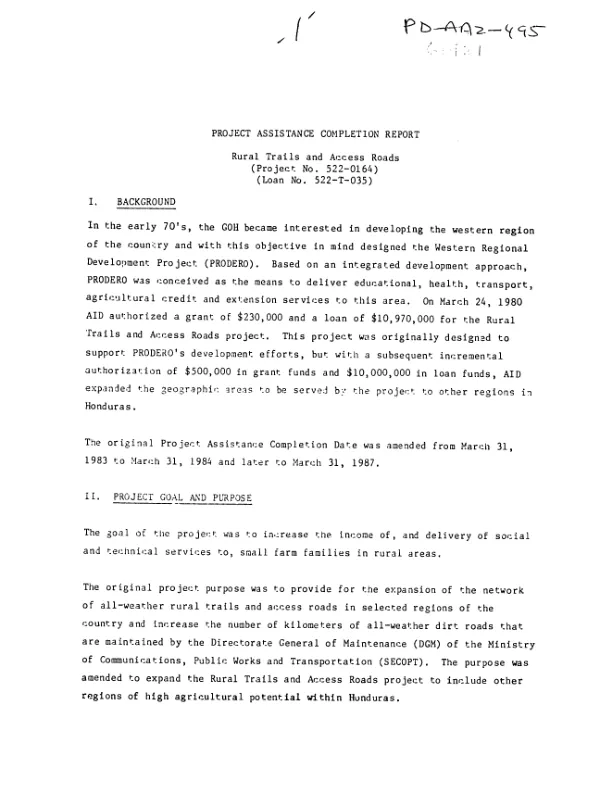
Project assistance completion report : rural trails and access roads (project no. 522-0164) (loan no. 522-T-035)
Sign inUSAID. MISSION TO HONDURAS
Project assistance completion report : rural trails and access roads (project no. 522-0164) (loan no. 522-T-035)
PACR of a project (3/80-3/87) to expand the network of all-weather rural trails and access roads in selected regions of Honduras and to provide equipment repair services to the Directorate General of Maintenance (DGM).
1989
Sign in to readA free account is required to download.
Abstract
The project met or exceeded all objectives in road and bridge reconstruction and maintenance equipment repair, having completed 1,510 km of roads and trails, 8 bridges, and the repair of 50 pieces of maintenance equipment. The rural roads constructed under the project cost an average of $16,750 a kilometer. In relative terms, the geographic area covered by the project experienced substantial increases in agricultural production, commerce, and access to education and health services. These improvements were largely due to agricultural and other extension services which could not work in the area until road construction facilitated their entry. Unfortunately, however, project achievements were partially nullified when many rural roads constructed under the project subsequently deteriorated due to lack of maintenance by the DGM. Rehabilitation of maintenance equipment was not an effective solution since the repaired equipment was diverted to other roads or uses. Voluntary community participation activities did not materialize as envisioned in the project design for two reasons: (1) the available workforce was insufficient because rural residents placed a higher priority on working in their fields and (2) contractors found it more efficient and therefore more profitable to use their own labor. Several lessons were learned. (1) If rural road construction works are well monitored, considerable savings can be realized by paying contractors on a unit price basis rather than an hourly basis. (2) Contracting out with a maximum contract of $500,000 expedites implementation and allows firm control over the project. (3) Construction projects with maximum contract awards such as $500,000 should allow smaller firms the additional time they generally need to obtain bonding and fulfill other legal requirements. (4) Construction manuals are indispensable for standardizing work that involves numerous contractors. (5) Effective use of a rotating fund permits timely payments to contractors. (6) Rural road construction projects, especially those that contract out to construction firms on a unit price basis, may find it unsuccessful to rely solely on volunteer community efforts for certain phases of the project. As has been demonstrated in the follow-on project, it is more realistic to provide community members some compensation for their labor.