USAID. MISSION TO HONDURAS
Rural roads II (522-0214) : project assistance completion report
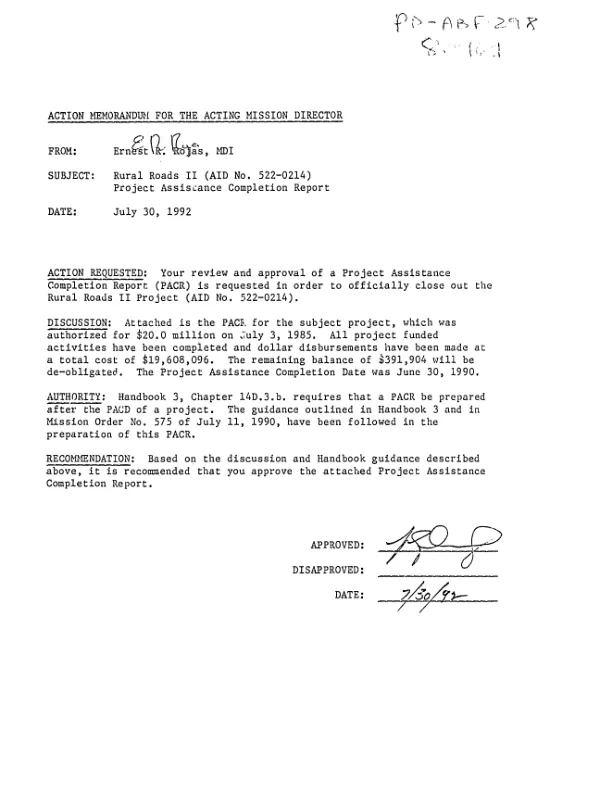
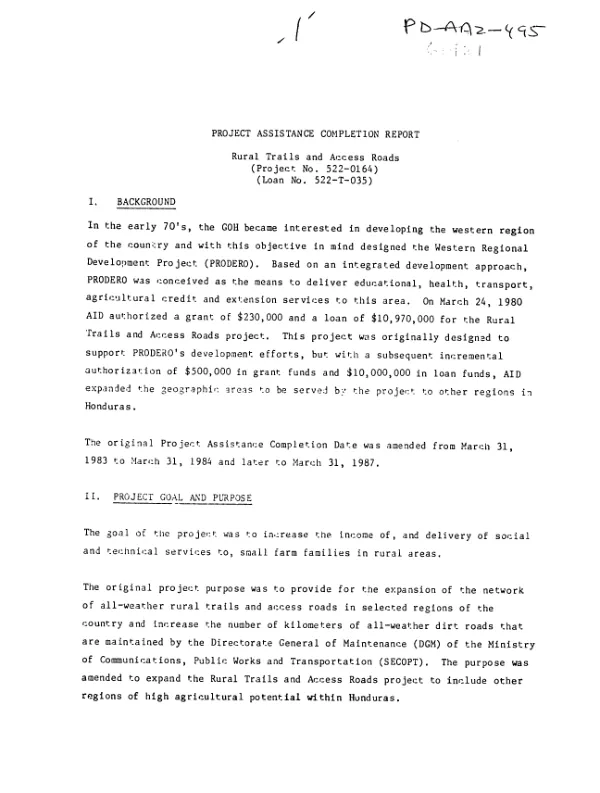
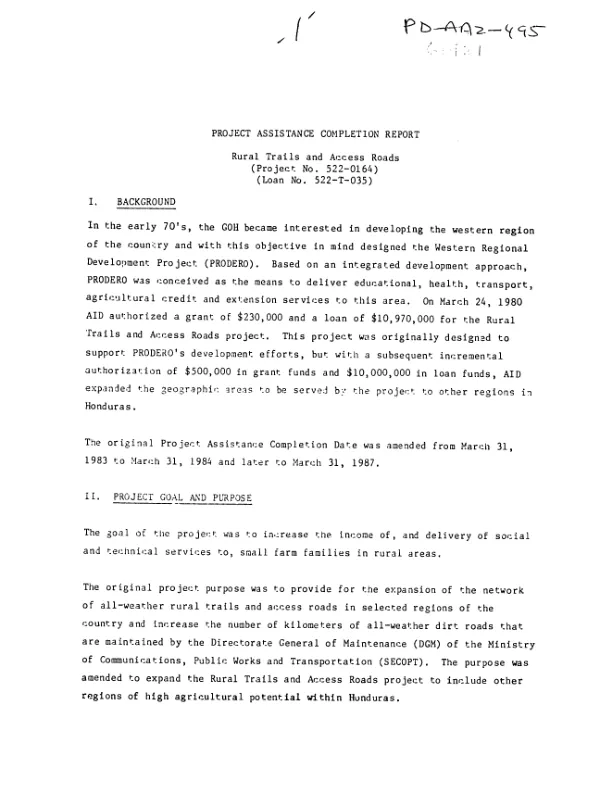
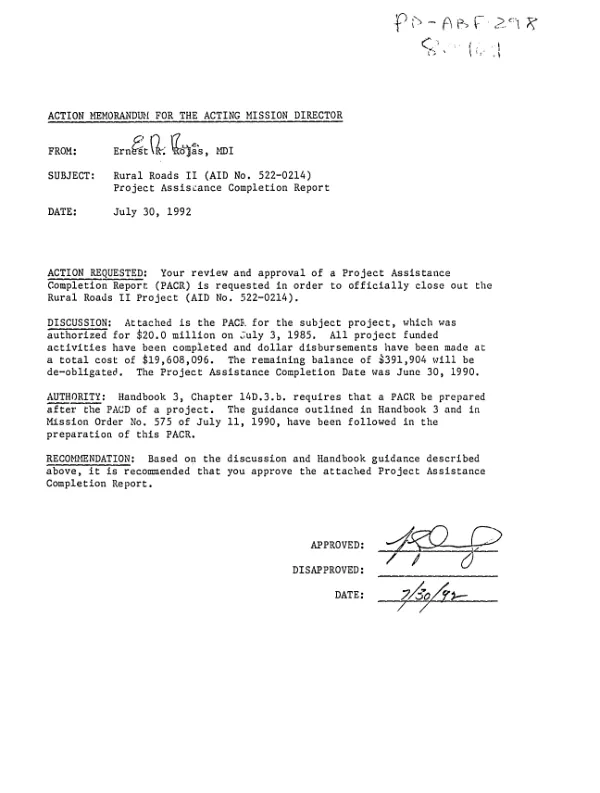
PACR of a project (7/85-6/91) to institutionalize a capacity for rural road rehabilitation and maintenance within the Government of Honduras (GOH), resulting in expansion of the country's all-weather rural road network by 1,000 km and proper maintenance of 1,500 km of access trails and roads reconstructed under a predecessor project (Rural Roads I -- 5220164).
1992
Sign in to readA free account is required to download.
Abstract
The Ministry of Communications, Public Works, and Transportation (SECOPT) was the principal counterpart agency. The project achieved all output targets and achieved additional outputs. The following planned outputs were achieved: (1) construction of 1,061 km of rural roads, including 255 linear meters of concrete bridges; (2) maintenance of 2,630 km of rural roads, including 1,956 km of routine maintenance provided by the labor-intensive Peon Caminero program; (3) distribution of a rural roads design and construction manual to SECOPT technical personnel involved in construction and maintenance; and (4) improvement of professional engineering skills within SECOPT and preparation of feasibility studies as a result of training received under the project. Unplanned outputs included: (1) rehabilitation of 102 km of rural roads in southern Honduras; (2) issuance of the document "Methodology for the Selection, Evaluation, and Prioritization of Rural Roads;" and (3) the purchase of computer equipment to implement a road maintenance planning tool called HDM (Highway Design and Maintenance), which permits SECOPT to plan road maintenance according to traffic volume, economic importance, availability of funding, and other factors. Despite this successful record, the GOH has not fulfilled its commitment to fully fund a maintenance program. This failure is part of a global problem generated by the economic recession and the lack of appropriate planning. Several lessons were learned. (1) All road construction projects should be accompanied by a road maintenance component, including a strong, verifiable maintenance commitment from the host government, an institutional strengthening program, and a modern inventory and planning tool such as HDM. (2) Except under special circumstances, road construction should be performed by private contractors, selected through public bidding processes, and chosen from pre-qualified firms. Pre-qualification should be updated every year. (3) Unit price contracts must be enforced, except for small activities and contingencies. Budgets should be as accurate as possible in order to anticipate contingencies and avoid the need for large Change Orders. (4) Project supervision improves when performed by private supervisors that report to the host country implementing agency.