USAID. MISSION TO SWAZILAND
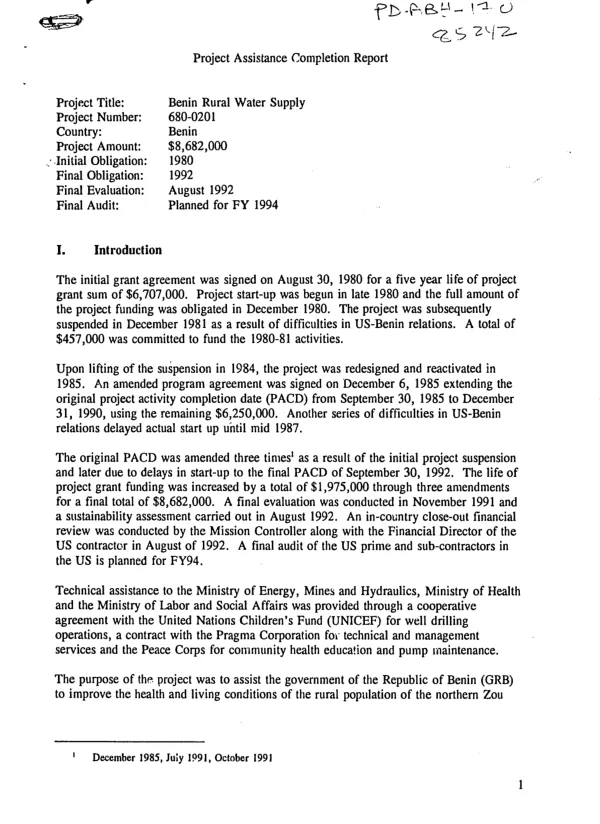
Project assistance completion report [: rural water borne disease control project]
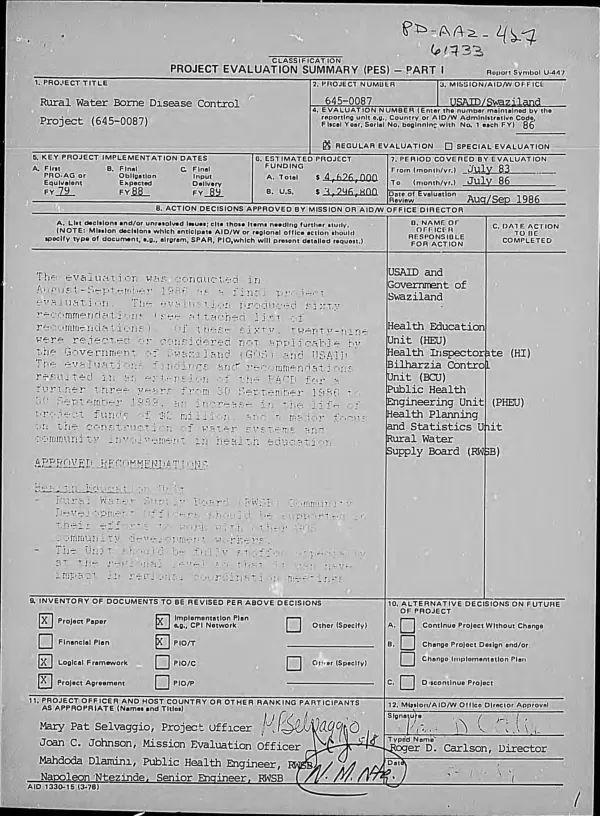
PACR of a project (1979-1989) to assist the Government of Swaziland (GOS) in expanding rural water systems to combat diseases related to water supply and poor sanitation.
Henwood, A. D. · 1990
Sign in to readA free account is required to download.
![Project assistance completion report [: rural water borne disease control project]](https://covers.devme.ai/gen/9016.webp)
Abstract
The project greatly increased the GOS Rural Water Supply Board's capacity to construct rural water systems. Although only 64 of a targeted 78 water systems were completed, the population served by the systems is about 42,000, or 35% more than originally planned. The latrine component also made good progress, with 3,500 begun and 2,000 completed, compared with the target of 3,000 completed. These achievements resulted in an increase in the rural population's access to water supplies from 20% to 45% and to rural sanitation from 15% to 25%. has been incorporated into the Ministry of Health's budget and will continue indefinitely. The project also strengthened the Health Inspectorate Unit. More than 90% of the Unit's staff were actively involved in latrine construction and can now adequately respond to community requests for construction assistance. Training was provided to health assistants, health inspectors, and community development officers in the supervision of community latrine programs, communication skills, and community motivation. Water committees in all regions of the country were trained in basic bookkeeping and preventive maintenance of their water systems. The project also supported development of a manual containing minimum design criteria for pit latrines which continue to be used in all pit latrine construction. Finally, project TA contributed a great deal to planning activities in the water and sanitation sector, culminating in a two-year plan which was updated in 1989. Three major lessons were learned. (1) The Fixed Amount Reimbursement mechanism is inefficient for funding such projects in Swaziland, since price increases which occur during the time gap between approval of cost estimates and actual construction can lead to cost overruns. (2) Interministerial linkages are essential if more than one implementing office is involved in project activities. (3) Long-range sectoral planning can be effective if the mechanisms focus on host government participation and not just external consultants.
Related documents
![Project assistance completion report [: rural water borne disease control project]](https://covers.devme.ai/gen/56896.webp)
![Project assistance completion report : cooperative agreement no. 519-A-00-99-00016-00 with CARE International El Salvador, under the project no. 519-0447 : MAREAS (Mitch actividades de rehabilitacion de emergencia en agua y saneamiento) [Hurriance Mitch emergency rehabilitation activities for water and sanitation]](https://covers.devme.ai/gen/26965.webp)