USAID DEC
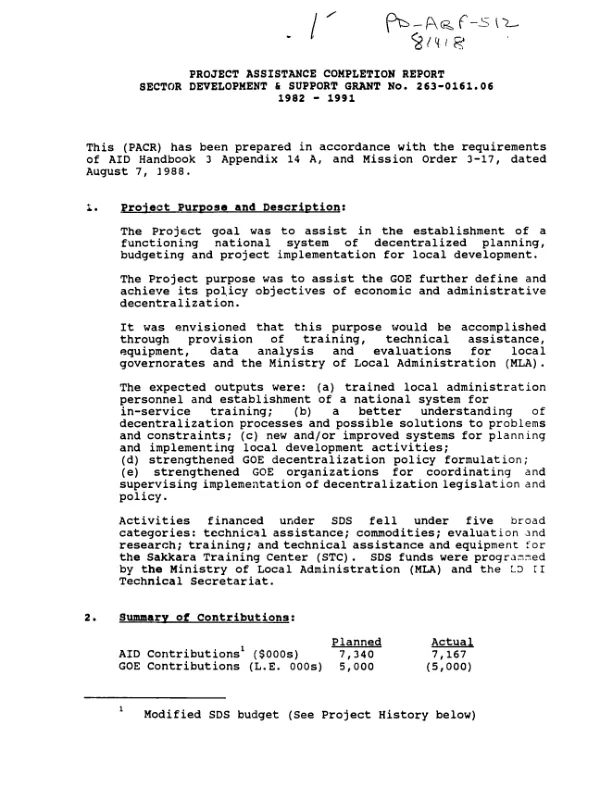
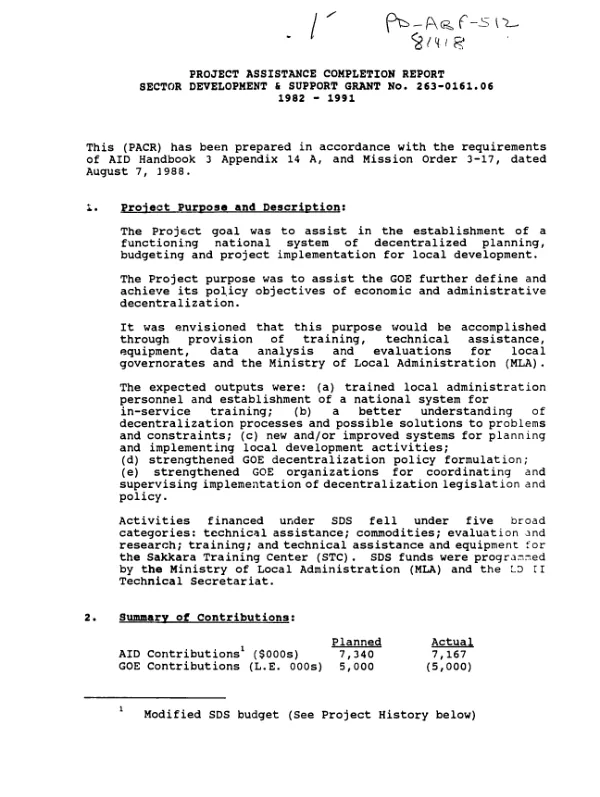
Project assistance completion report : sector development and support grant no. 263-0161.06, 1982-1991
Sign inUSAID. MISSION TO EGYPT
Project assistance completion report : sector development and support grant no. 263-0161.06, 1982-1991
Presents final Mission report on a project (1982-91) to support, in conjunction with four other projects, the Government of Egypt"s policy of economic and administrative decentralization.
1992
Sign in to readA free account is required to download.
Abstract
The five projects were originally known collectively as Decentralization Sector Support (DSS). When DSS ended, the present project continued under the Local Development II (LD II) program. While the project provided useful support to decentralization efforts and its training efforts increased local capacity and management, the overall objective of facilitating fiscal and administrative decentralization was not realized. DSS"s basic assumption -- that the decentralization trend that started in the 1960"s would continue and be significant -- did not hold true during the life of the project, but suffered a setback in the late 1980"s due to a mounting need for the central government to control the budget deficit and due to continued security concerns. However, by the project"s last year (1991), decentralization and change in local administration law were again being debated. More than 40% of the original project budget was to be used to provide start-up TA to an important local government training center that the GOE was building at Sakkara. Construction was considerably delayed, however, and when the center was finally ready to begin operations, its management was put in the hands of a central GOE ministry, which refused project TA and which also failed to acquire appointed staff or a regular budget for the center. Given this lack of GOE commitment, funds programmed for the center were shifted to other training activities, where they were effectively applied. The project"s major training effort took place under the Training Block Grant (TBG) activity, which is now operational under the LD II program. More than 32,000 persons, including governorate officials, local leaders, and PVO members, have received management training under TBG; 16% were women. A recent assessment of TBG was very positive and urged its continued support. The project also funded a number of research activities, most notably the successful rural small-scale enterprise pilot credit activity, which, beginning with $750,000, disbursed 9,519 loans totaling $2.53 million at market rates, and has now been expanded into a full-blown project. The project teaches these lessons. (1) Given the problems with the Sakkara Center, future funds should not be allocated to support operations of GOE projects under construction without a firm national commitment. (2) USAID policies that forbade paying honoraria to GOE officials who taught TBG classes proved counterproductive because GOE policies allow officials to receive honoraria for special duties (even if performed during normal working hours). Henceforth, training programs using GOE officials either should be funded by the GOE or USAID honoraria regulations should be waived at the design stage.