USAID DEC
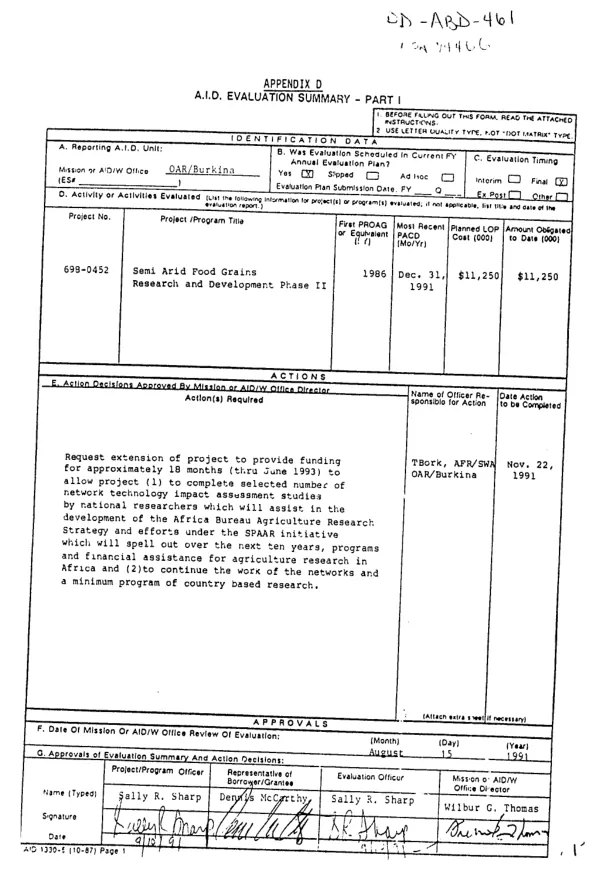
Project assistance completion report : semi-arid food grains research and development II (SAFGRAD) -- 08/30/86-03/31/92
Sign inUSAID. BUR. FOR AFRICA. OFC. OF REGIONAL AFFAIRS
Project assistance completion report : semi-arid food grains research and development II (SAFGRAD) -- 08/30/86-03/31/92
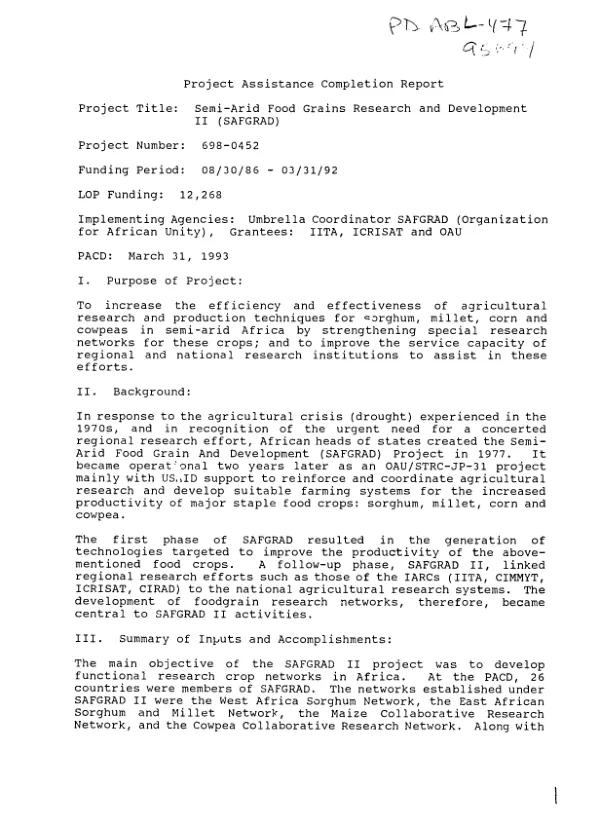
PACR of a project (8/86-3/92) to establish research networks for food grains in semiarid Africa.
1995
Sign in to readA free account is required to download.
Abstract
The project was implemented by the Organization for African Unity (OAU), the International Institute for the Tropical Areas (IITA) and the International Crop Research Institute for the SemiArid Tropics (ICRISAT). The project has had a significant impact. Agricultural research and production were strengthened through the development of the West Africa Sorghum Network, the East African Sorghum and Millet Network, the Maize Collaborative Research Network, and the Cowpea Collaborative Research Network, each of which were linked with IITA and ICRISAT. The Corn Network developed early maturing varieties (which made possible the expansion of corn production into dryer areas), as well as streak resistant variety SR 22; in addition, row planting was introduced. The Cowpea Network developed low-input varieties and cultivars capable of wide adaptations and introduced tied-ridging to enable soil to retain a larger share of rainfall. The Sorghum/Millet Network introduced sorghum variety S35 into northern Cameroon and more recently into Chad, and identified sorghum varieties for industrial uses such as brewing. The networks also developed new agricultural technologies, including an integrated Striga control package, as well as crop varieties with insect and drought tolerance. The project substantially built up institutional food grain research capacity in semiarid Africa. Specifically, it played a major role in strengthening national agricultural research systems (NARS) by identifying production constraints for different crops, assigning research responsibilities to different NARS to overcome these constraints, funding the research, training scientists, and providing opportunities for networking. The project had a substantial economic impact in West Africa. In Ghana, for example, the area in improved maize cultivars increased from 20% in 1982 to 55% in 1991. The annual social benefits (i.e., lower food prices) from maize research ranged from $4.8 million to $84 million, for an estimated internal rate of return of 73%. High social benefits -- ranging from $800,000 to $12.3 million over the period 1984-91 -- were also estimated for maintenance research on cowpeas in Mali and Burkina Faso. Overall, there is substantial evidence of diffusion of new cultivars and, to a lesser extent, of the improved agronomic techniques related to them. Diffusion of sorghum and millet was substantially less than that of new maize and cowpea varieties, possibly because breeding was overemphasized with sorghum and millet. The following lessons were learned. (1) Through the development of networks, the project encouraged national researchers to work in multidisciplinary teams to solve agricultural production problems. It promoted the exchange of scientific information, personnel, and new technology, and helped to dissolve linguistic barriers among anglophone, francophone, and lusophone countries. (3) Project support enabled the NARS to improve their research outputs both qualitatively and quantitatively. As a result, strong linkages were established between NARS scientists and farmers through extension workers, NGOs, and farmer organizations. (4) Closer collaboration is needed between donors and project implementing organizations to ensure project continuity. (5) Even after the conclusion of the project, the OAU maintained linkages with network activities currently being managed by IITA and ICRISAT, indicating that the OAU Coordination Link developed by the project continues to be important.