USAID. MISSION TO SUDAN
Project assistance completion report [: Sudan renewable energy project]
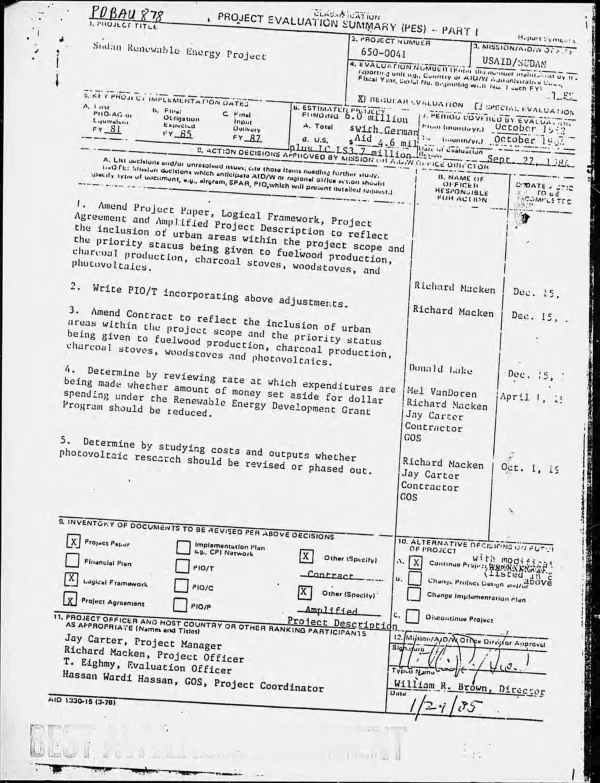
PACR of a project (5/88-2/90) to promote renewable energy technologies in Sudan by providing support to the two entities of the National Council of Research -- the Renewable Energy Research Institute and the Energy Research Council (ERC).
1990
Sign in to readA free account is required to download.
![Project assistance completion report [: Sudan renewable energy project]](https://covers.devme.ai/gen/9128.webp)
Abstract
The project established a center of technical expertise that is now the country's primary research agency in several key areas, including stove testing, biomass research, and power systems (including diesel systems). Planning and implementation were accomplished collegially, with counterpart staff taking primary responsibility, and sustainability appears likely. A major highlight was the project's ability to avoid the common pitfall of unrealistic, economically questionable research applications. This was accomplished through rigorous, impartial elimination of technologies lacking in replicability or commercial potential and by emphasizing dissemination. The project played a key role in redirecting Sudan's stove programs by a rigorous effort to disseminate a metal stove designed by the University of Khartoum's Faculty of Engineering. The effort demonstrated the weakness of the stove's design in the long term, resulting in its abandonment in favor of a stove similar to the Kenya Jiko stove. The project also established the country's only stove testing center, located in Soba. A significant number of mid-level and senior-level project staff received short- or medium-term training outside Sudan. Although an overseas program for Master's degree training proved too expensive, a forestry program was developed within the University of Khartoum, which is providing trained graduates to the ERC. A counterpart small grants program was well managed, with most grants provided to farmers and corporations for forestry/agroforestry activities. Stronger forestry counterparts would have made these efforts more effective. A major lesson learned is that countries with available counterpart funds and large numbers of trained technical staff can undertake a variety of activities with relatively minimal external TA. The project also demonstrates that it is possible to develop a research organization emphasizing dissemination, outreach, and impact.
Related documents
![Project assistance completion report [: Sudan renewable energy project]](https://covers.devme.ai/gen/47456.webp)