USAID. MISSION TO SUDAN
Sudan renewable energy project
Evaluates project to develop the capabilities of the Government of Sudan (GOS) to develop and disseminate renewable energy technologies (RET"s) in rural areas.
Carter, Jay; Macken, Richard · 1985
Sign in to readA free account is required to download.
Abstract
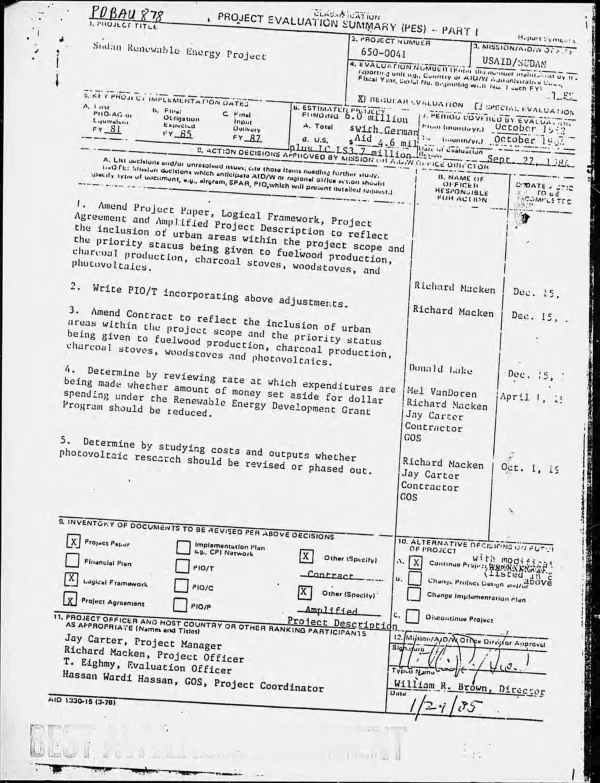
PES covers the period 10/82-10/84 and summarizes an attached Special Evaluation (XD-BAU-878-A) based on site visits, document review, and interviews with GOS, contractor, and other-donor personnel. Although progress during its first year was slow, due to overemphasis on institutional development and to conflicts between GOS and project staff over project design, the project has since adopted an action approach and has accomplished much. Unlike most energy projects, the project has avoided becoming mired in studies (only a few have been conducted) and has been particularly effective in fielding staff, equipment, and funds (largely local currency) through 24 Rural Energy Development Grants (REDG"s) to small-scale RET activities. The project now focuses mostly on biomass production and use (e.g., 17 REDG"s were awarded for forestry/fuelwood, 5 for photovoltaics, and 2 for charcoal stoves) and favors process and replicability in RET development over hardware outputs. Also, the geographical focus has shifted to include urban areas, as urban dwellers are the major charcoal users and these areas offer greater opportunity for successful innovation and diffusion. Construction and equipping of the German-funded Renewable Energy Research Institute (RERI) facility and information center has been delayed, and completion is expected in 1987. Lastly, several problems remain regarding the M.Sc. program at the Universities of Khartoum and New Mexico; although students are scheduled to depart for the overseas portion of the program in 1/85, onsite study has not been fully arranged, and, furthermore, the curriculum for only 4 of the 8 students relates to priority project areas. Action decisions are to: amend the project to reflect its inclusion of urban areas and its current priorities; determine if dollar spending for RDEG"s should be reduced, photovoltaic research should be continued, and household woodstoves should remain a priority; develop an integrated renewable energy strategy to structure project elements; and effect better project communication and coordination.
Related documents

![Project assistance completion report [: Sudan renewable energy project]](https://covers.devme.ai/gen/9128.webp)