USAID DEC
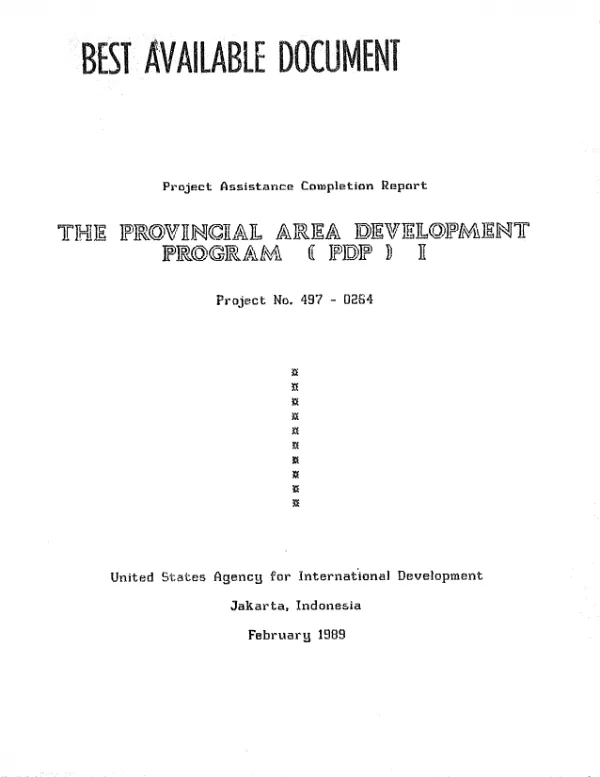
Project assistance completion report : the provincial area development program (PDP) I
Sign inUSAID. MISSION TO INDONESIA
Project assistance completion report : the provincial area development program (PDP) I
PACR of a project (1977-88) to increase the capacity of (1) local governments in Central Java and Aceh Provinces in Indonesia to design, implement, and evaluate rural development projects and (2) central governments to support these efforts.
1989
Sign in to readA free account is required to download.
Abstract
A total of 1,119 subprojects (SP's) were completed. In Central Java, successful SP's were in integrated agriculture, food crop and livestock production, fish pond establishment, assistance to poor families, skills training, subdistrict area development (PPWK), and rural credit (BKK). The PPWK, BKK, and livestock (particularly sheep and goats) SP's proved particularly successful and replicable. Unsuccessful SP's were in eel and fish production in public waters, mixed breed chicken raising, silage production, land conservation, and seawater distillation for drinking water. SP's in Aceh were not as successful, though some success was had in SP's in agriculture, embroidery, and traditional dagger production, and the rural credit program made headway after a poor start. Salt production and marine fishery SP's were unsuccessful. In both provinces, lack of success was due to insufficient technical instruction and inadequate feasibility studies. SP's had a significant impact on beneficiaries: targeting success was quite high and the average real net gain represented an 11-18% real increase in average annual household income for recipients reporting a gain. The project also developed improved planning and information systems in the two provinces and provided in-country and overseas training to a total of 800 local and central government officials in such areas as rural regional development planning, integrated rural development, community development, etc. About 8,000 persons involved in the SP's were also trained. The project's orientation to the rural poor and the appointment of regional development planning boards at both the provincial and district levels to control project funds had a very positive impact on strengthening local government structural integration and coordination both vertically (delegating development management and planning authority from the central to the provincial and in some cases to the district and subdistrict levels) and horizontally (within the Technical Service Agencies at the provincial and district levels). In sum, as a result of the project Aceh and Central Java provinces now possess reliable infrastructures - improved staff and management systems and replicable SP packages of proven effectiveness in increasing rural employment and income. Central Java has shown strong indications of continuing project activities and even expanding them to a new district. Results in Aceh are less conclusive, as only Rp. 78 million have been allocated to continue project activities.