USAID DEC
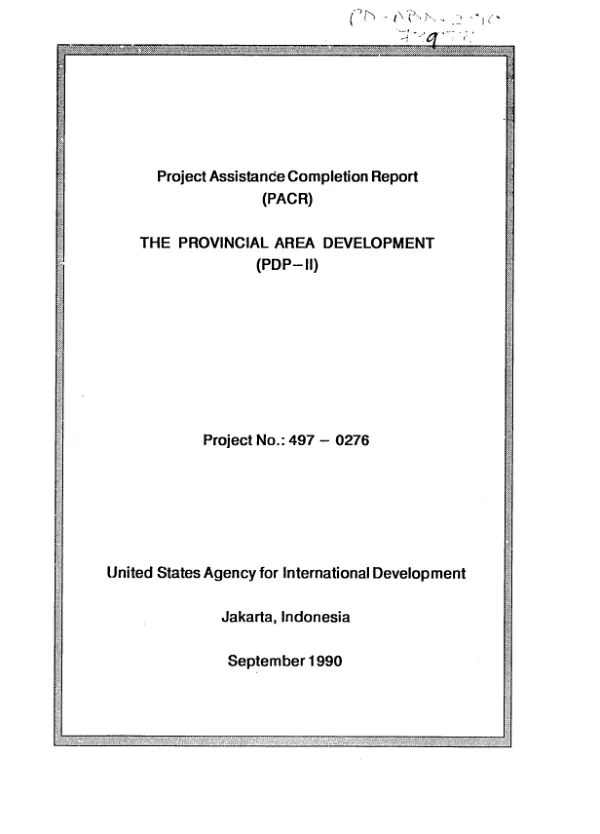
Project completion assistance completion report (PACR) : the provincial area development (PDP-II)
Sign inUSAID. MISSION TO INDONESIA
Project completion assistance completion report (PACR) : the provincial area development (PDP-II)
PACR of a project (1979-89) to support development subprojects (SP's) in rural Indonesia and upgrade the capabilities of local and central government agencies to plan, implement, and support decentralized development programs.
1990
Sign in to readA free account is required to download.
Abstract
A total of 2,379 SP's, mostly in agriculture and public works, were completed in the six target provinces -- Bengkulu, West Java, South Kalimantan, East Java, West Nusa Tenggara (NTB), and East Nusa Tenggara (NTT) -- directly benefitting about 348,840 poor, rural families. Particularly outstanding were the rural credit programs, which were the catalyst for the Financial Institution Development Project. Other successes included food crop production, livestock development, and drinking water SP's. On the negative side, estate crop SP's for tree production, though widespread, produced little benefit due to the time lag between investment and first harvest, and small-scale industry and fisheries SP's had only limited success. Except for some of the new technology transfer activities, the experimental SP's were generally not successful enough to be replicated. The project had significant positive impacts on the intended beneficiaries, an estimated 65% of whom were correctly targeted project-wide. Household incomes were increased an average of 120% in real terms; NTB led the way with a net gain of Rp. 143,000. By sector, small industry created the highest net gain at Rp. 223,000. Training was a key element in this success, with more than 34,000 villagers receiving some kind of training through the project. In terms of sustainability, 73% of SP's were judged sustainable, with the highest rate (86%) in NTT and the lowest (68%) in South Kalimantan. By activity, irrigation SP's had the highest level of sustainability (90%) and fisheries the lowest (43%). It is estimated that 56% of SP's are likely to continue, provided the current minimum net gain of Rp. 30,000 remains an acceptable level of return to the beneficiaries. Project TA and in-service training, as well as U.S. training of 41 officials, increased government capacities to manage development, especially at the provincial and sub-provincial levels. A comprehensive, decentralized development planning system was developed and implemented by the lead agency, the Directorate General for Rural Development (BANGDA), and the regional development planning bodies (BAPPEDA's); the new system was even adopted by non-project provinces. Also of significance is the Government of Indonesia's commitment to continuing project approaches and systems. The project has clearly demonstrated the feasibility and viability of a decentralized, "bottom-up" approach to development involving provincial, district, subdistrict, and village levels of administration, as well as inputs from PVO's, NGO's, women's organizations, and the public at large. were identified regarding: (1) administrative coordination and information exchange between lead and local agencies; (2) market development constraints, especially those affecting small-scale industry SP's; and (3) funding delivery mechanisms of the Government of Indonesia and the project.