USAID DEC
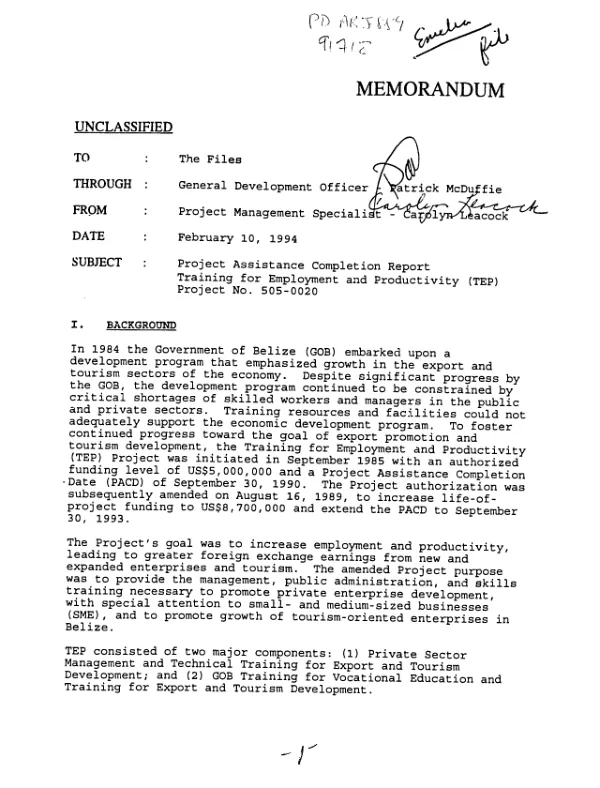
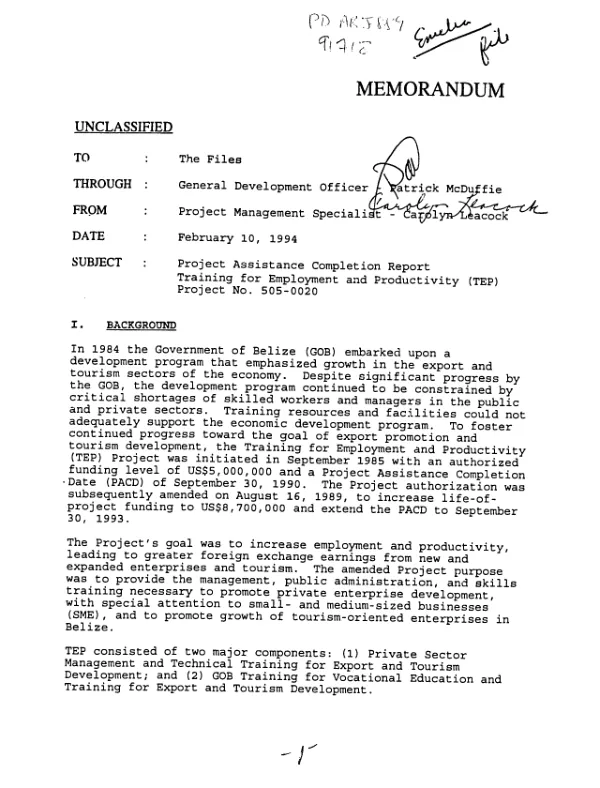
Project assistance completion report : training for employment and productivity (TEP) project no. 505-0020
Sign inUSAID. MISSION TO BELIZE
Project assistance completion report : training for employment and productivity (TEP) project no. 505-0020
PACR of a project (9/85-9/93) to strengthen private enterprise training in Belize, in both the public and private sectors.
1994
Sign in to readA free account is required to download.
Abstract
Under the private sector component, organizational objectives for the Belize Institution of Management (BIM) were largely achieved. Key administrative and support positions were filled (despite a lack of experienced Belizean managers), a management and business training center was constructed, and U.S. and on-the-job training were provided to develop a cadre of part-time instructors who collectively deliver some 42 seminars annually, mostly in general management. In recent years, declining attendance at the seminars led BIM"s Board of Directors to develop a strategic plan which bases seminar delivery on needs assessment. These efforts have yet to bear fruit, however, and BIM has failed to develop significant profit centers. Quantitatively, BIM exceeded its training targets for private sector and small/medium enterprise managers by 411% and for public officers by 444%. Female participation in private sector management training was slightly less than planned at 45%, while female participation in the public sector was 52%. In the Belize Tourism Industry Association (BTIA) subcomponent, the project helped the BTIA to establish an office and develop administrative systems and a comprehensive 5-year strategic plan. In addition, members of the BTIA"s executive board received participant and in-country training, and a long-term advisor was provided. The extent to which these organizational gains are sustainable will have to be determined under the Tourism Management project (5050004), to which BTIA development has been transferred. Under the present project, the BTIA delivered 18 short-term training seminars in such areas as hotel and hospitality management, pricing of tourist services, and catering and food preparation, at 9 major geographic travel destinations. In the public sector component, the Ministry of Education"s (MOE) ability to deliver short-term vocational training was developed and strengthened. The Centre for Employment Training (CET) became operational and delivered short-term skills training to early school leavers and individuals from private businesses and industry, and long-term skills training to students of former junior professional schools; also, two new programs, construction trades and auto mechanics, were added. CET instructors, who were largely drawn from the private sector, received upgrading through U.S. and in-country training in competency-based instruction, technical fields, and CET"s vocational training philosophy. On the management side, CET personnel were trained in the management of vocational schools, management information systems, counseling and job training, and educational remediation. CET staff were employed under contract to the CET (rather than as permanent MOE appointments) and their salaries were higher than usual for vocational instructors. Finally, a coordinating and advisory committee composed of representatives from business, industry, the MOE, and the general community was established to manage the CET. This structure has proven successful, providing the CET relative autonomy from the MOE, increased input from the labor market, and better job placement services and resource identification. Finally, the subcomponent to improve the Government of Belize"s (GOB) capacity to implement its enterprise and tourism development strategy through training in public administration was achieved, with 1,776 public officers (52% of them female) trained against a target of only 400. Trainees have given their training high marks, though many have reported difficulty in utilizing their training due to a restrictive and unenlightened management environment. Lessons learned are as follows. (1) Sustainability, which is a critical factor in organizational development and the core of program and activities planning, must be deliberately planned for at the project design stages. (2) Management training and development is successfully achieved only when strategic management is regularly used, clients participate in determining training needs, and there exist true leadership, a professional staff, sound financial planning, faculty development, regular program evaluation, and organizational autonomy. (3) Vocational education projects require a complete assessment of all pertinent policy and economic conditions, rather than just identification of needs for skills training in technical fields. Also, vocational training policy is more likely to be successful if it provides for development of youth and unskilled workers, as well as linkages between employers and training schools. Multiple funding sources increase the chances of sustaining vocational educational development. (4) To be effective, public sector management training needs to be combined with a supportive management and policy environment. (5) Project assistance for tourism industry development in Belize should be determined by a more holistic analysis of needs, conditions for implementation, and fit with other interventions.