USAID DEC
Project assistance completion report : typhoid prevention and control -- FY 1991 section 414 (b) commodity monetization, OGSM/416 DDP-G-532-1/635/00
Sign inUSAID. MISSION TO JAMAICA
Project assistance completion report : typhoid prevention and control -- FY 1991 section 414 (b) commodity monetization, OGSM/416 DDP-G-532-1/635/00
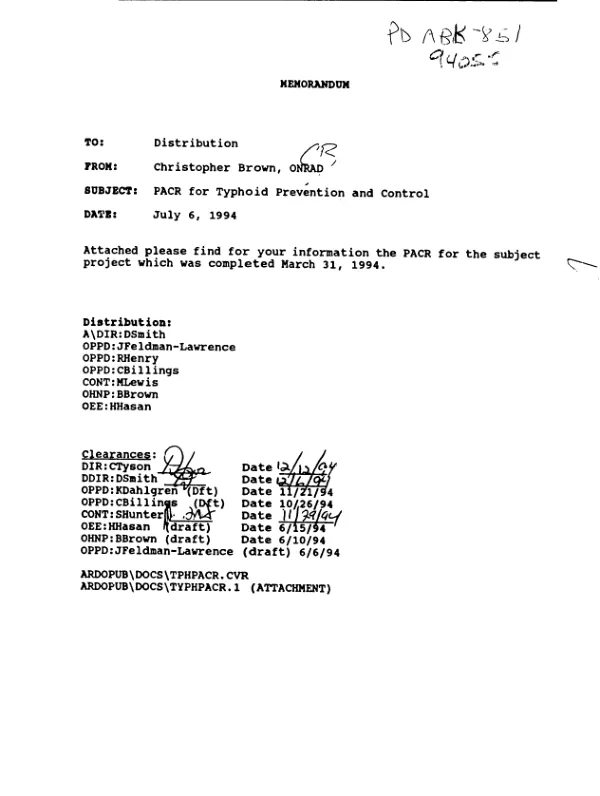
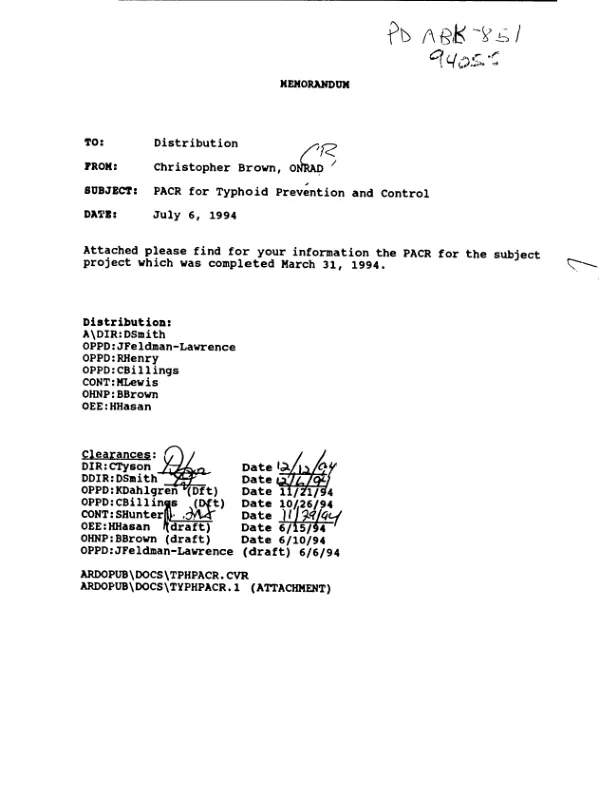
PACR of a project to implement a typhoid prevention and control program in Savanna la Mar, Westmoreland, Jamaica.
1994
Sign in to readA free account is required to download.
Abstract
U.S. assistance was funded under a Section 416 (b) commodity monetization agreement, which was signed in 4/91; the project was completed in 3/94. Accomplishments were as follows. (1) Clinical and epidemiological surveillance were upgraded. Regional medical authorities established a functioning epidemiological surveillance unit which will provide fast response to future disease outbreaks in the area. In addition, improvements to the Savanna la Mar Hospital laboratory provide a capability for testing and treating suspected typhoid sufferers which did not previously exist in Westmoreland. (2) There is anecdotal evidence that project health education activities significantly increased awareness of the causes, symptoms, and treatment of typhoid. However, a series of focus group seminars indicates that behavior patterns have not changed accordingly. (3) The project improved the original treatment plant facility for the Roaring River water Distribution System, including education and monitoring of operators, strengthening of operational controls, and improved monitoring of water quality. Moreover, project construction, when completed in 7/94, will double the capacity for treated water output to 5 million gallons/day, thereby addressing the prime factor suspected of leading to recent typhoid outbreaks. The project also has been able to provide metered potable water to several squatter settlements which previously lacked access to clean water. However, required general improvements to the Savanna la Mar area distribution system proved too extensive and beyond the project's financing capability. A major pipe replacement is needed to control leaks. (4) Finally, completion of over 1,000 pit latrines in and around Savanna la Mar met the original target and will improve sanitary conditions. Five public sanitary conveniences built under the project will also improve sanitation. However, at least another 1,000 pit latrines are still needed, and the project could not bring any of the improvements initiated on waste treatment plants to completion, largely due to customs difficulties. Due to a conflict with an ongoing cholera prevention project of the Ministry of Health, work on the treatment plant at Savanna la Mar Hospital never even began. Lessons learned are as follows. (1) In commodity monetizations, USAID should first identify other donor plans as well as the demand for the commodity. In this project, butteroil imported under the U.S. program competed with parallel butteroil imports of the World Health Program in a highly inflationary environment; as a result, the U.S.-provided butteroil took over a year to sell off. (2) The implementing entity should be made the reporting entity from the beginning, and reporting requirements and format should be clearly established up front. In the present case, the Planning Institute of Jamaica (PIOJ), tasked with reporting, was completely dependent on the implementing agency, the UN Development Program, for information. As a consequence, PIOJ relinquished the reporting function, except for commodity sales data, to UNDP, which, however, proved highly resistant to USAID reporting needs and failed to provide useful data on progress. (3) Construction activities always take longer than expected. Given the high rate of inflation in Jamaica, additional time means significant increases in Jamaican dollar costs. Consequently, budget estimates need to factor in expectations for significant cost increases.
Related documents
Documents in this collection
 1994
1994USAID DEC
Project assistance completion report : typhoid prevention and control -- FY 1991 section 414 (b) commodity monetization, OGSM/416 DDP-G-532-1/635/00
Open record![Final evaluation report : USAID health systems management project (9517-0153 [i.e. 517-0153]) -- disease control component, Dominican Republic](https://covers.devme.ai/gen/8621.webp) 1991
1991USAID DEC
![Final evaluation report : USAID health systems management project (9517-0153 [i.e. 517-0153]) -- disease control component, Dominican Republic](https://covers.devme.ai/gen/37109.webp)