USAID DEC
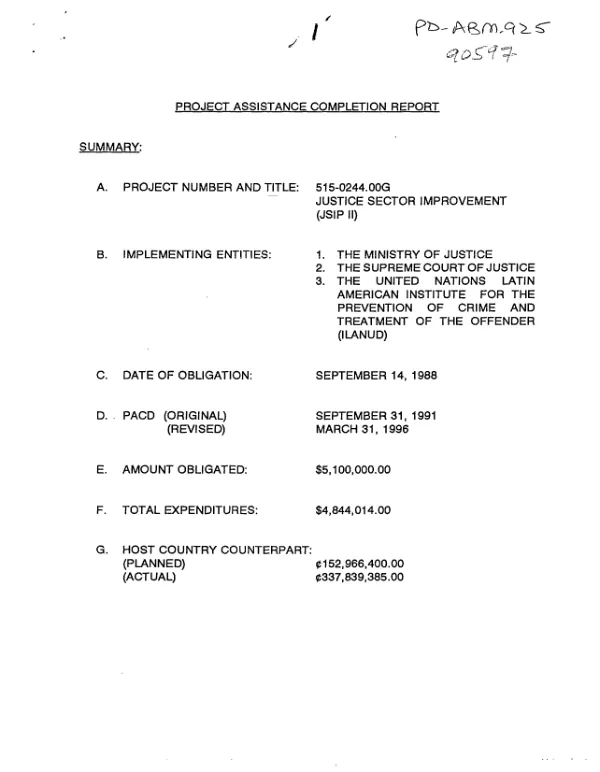
Project assistance completion report : USAID grant agreement no. 515-024-G-00-2133-00 [i.e. 515-0241-G-00-2133-00] -- legislative development program : Costa Rica
Sign inUSAID. MISSION TO COSTA RICA
Project assistance completion report : USAID grant agreement no. 515-024-G-00-2133-00 [i.e. 515-0241-G-00-2133-00] -- legislative development program : Costa Rica
PACR of a project (2/92-2/96) to support legislative development in Costa Rica.
Sign in to readA free account is required to download.
![Project assistance completion report : USAID grant agreement no. 515-024-G-00-2133-00 [i.e. 515-0241-G-00-2133-00] -- legislative development program : Costa Rica](https://covers.devme.ai/gen/6480.webp)
Abstract
The project was implemented by the Center for Democracy (CFD). Achievements made toward the project's six major goals are as follows. (1) To help institutionalize the legislative development process, CFD provided TA to help the Legislative Assembly's Modernization Commission identify goals, set priorities, and develop numerous activities. Specific achievements included a Master Plan for development and modernization of the Assembly; a permanent, multi-partisan Commission on Modernization and legislative development; and an agreement to co-finance specific training and legislative TA programs. By investing in modernization, the Assembly not only demonstrated its commitment to the project, but also established a precedent for including funding for similar activities in future budgets. (2) For the most part, efforts to modernize the Assembly led to computerization and staff training rather than basic changes in organizational structure, administration, or procedure. A new set of rules of order prepared by a CFD consultant is expected to be voted upon prior to 5/96. If this does not happen, it is likely that the issue will not be re-opened until after the 1998 presidential elections. (3) Helped by a needs assessment conducted by the Central American Institute for Business Administration (INCAE), the project offered a legislative development program for legislators and their staffs combining training (generally through the University of Costa Rica's Center for Research and Training in Public Administration [CICAP]) and publications. Participation in the program has been very strong: the courses earn civil service points and are also pertinent to the Assembly's work. One of the program's most significant legacies is the Assembly's awareness, at every level, of the importance of this training. (4) A highlight of efforts to develop institutional linkages between the Assembly and other national and international institutions on the one hand and the Costa Rican public on the other was the creation, during the contract extension period, of the Program for Legislative Development (PRODEL), ratified by the Legislative Directorate in 9/94. PRODEL, which taps the resources of CICAP, provides high-level TA to legislators in developing legislative studies and drafting proposed bills on specialized subjects of national importance. PRODEL also organizes seminars, workshops, and conferences, and produces publications of legislative interest. (5) With TA from CDF, the Assembly purchased an integrated Legislative Information System (SIL), which currently extends to the offices of the 57 deputies and all the legislative offices (though not yet the administrative offices). Data bases and online services available through SIL include the Daily Legislative Calendar, Plenary and Committee Minutes, Legislative "e-mail", Current Law (SLV), Bill Analyses, National Registry Data, Finance Ministry information, National Socio-Economic Statistics, INTERNET, and Legislative Library Services. The results of computerization are already being felt in the Assembly, the investment of whose own funds is but one more indication of its commitment to modernization. (6) Regarding coordination of multi-donor contributions to the Assembly, outside assistance will be sought to continue the Master's Program in Legislative Studies and an effort will be made to involve legislative staff from other Central American Parliaments. Proposals for co-funding continuation of the legislative TA program have already been presented to a number of donors. The Assembly is committed to continuing its legislative development program. Lessons learned are as follows. (1) Legislators and staff should be involved in developing a needs assessment. (2) Parliament should "institutionalize" the legislative development process by establishing a permanent, multi-partisan commission of legislators (to include a representative of the ruling body of the legislature) to oversee all modernization efforts. This commission should adopt an annual work plan and make decisions only by consensus. (3) Parliament should be required to contribute financially to all projects undertaken. (4) Great care should be taken to maintain balance between political parties in all activities. (5) The program should be guided by a small, "politically balanced" executive committee of respected former legislators and staff and should engage only in activities specifically approved by the multi-partisan commission. (6) Every effort should be made to involve and communicate with the Parliament's permanent legislative and administrative staff. (7) Legislative development programs should be institutionalized through a permanent linkage with a major university. (8) Making public policy is the responsibility of elected legislators. Everyone else should focus on making sure that the legislators' decisions are based on the best information available and that the legislative institution and process are functioning as efficiently and effectively as possible.
Related documents
Documents in this collection
![Project assistance completion report : USAID grant agreement no. 515-024-G-00-2133-00 [i.e. 515-0241-G-00-2133-00] -- legislative development program : Costa Rica](https://covers.devme.ai/gen/83708.webp) 1970
1970USAID DEC
Project assistance completion report : USAID grant agreement no. 515-024-G-00-2133-00 [i.e. 515-0241-G-00-2133-00] -- legislative development program : Costa Rica
Open record 1992
1992USAID DEC