USAID DEC
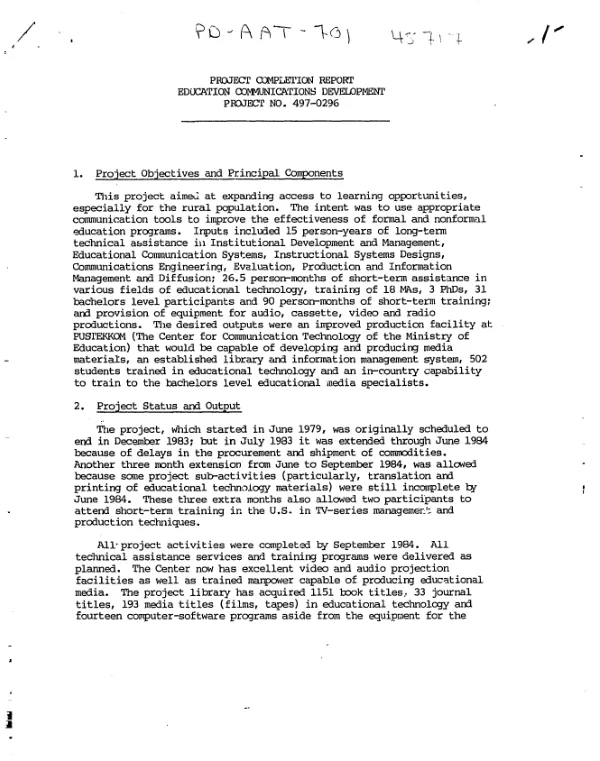
Project completion report : education communications development project no. 497-0296
Sign inUSAID. MISSION TO INDONESIA
Project completion report : education communications development project no. 497-0296
Presents final Mission report on a project (6/79-9/84) to upgrade the capability of the Indonesian Ministry of Education"s Center for Communication Technology (PUSTEKKOM) to improve formal and nonformal education, especially in rural areas.
1985
Sign in to readA free account is required to download.
Abstract
With all planned TA and training completed, PUSTEKKOM now has all the facilities and the trained personnel needed to produce sophisticated educational materials. The project library has acquired 1,151 book, 33 journal, and 193 media titles in educational technology, as well as 14 computer software programs and audiovisual and graphics equipment. PUSTEKKOM achievements include helping the newly established Open University to develop materials and, at the direction of the Minister of Education and Culture, producing 52 films entitled "I Love Indonesia" for television (its next major activity, also at the Minister"s Direction, will be to produce films on Indonesian history). Recently, the chairman of the Ministry"s Office for Education R&D (BALITBANG DIKBUD) placed PUSTEKKOM in charge of planning and developing software materials in two subject areas for junior high schools. PUSTEKKOM is also responding to requests from various government offices for training in instructional software development. The University of Southern California (USC), a subcontractor of the Academy for Educational Development (AED) in the training component, proposed a novel approach to participant training: a U.S. faculty traveled to Indonesia to provide 1-month intensive courses in Master"s and doctoral areas where Indonesian schools were lacking. USC thereby both greatly increased the number of students trained and helped developed an in-country capability to offer graduate training in educational technology (a secondary project objective). The failure of the project design to coordinate participant training and TA and to provide adequate administrative support to the Chief of Party, as well its underestimation of the time needed to deliver commodities, revealed the importance of these matters. The project also taught the importance of host country counterparts; the staff of BALITBANG DIKBUD, the implementing agency, too often lacked management capability or hesitated to exercise authority, and the agency, moreover, was undergoing reorganization during most of the project. In this project, it was difficult to reach a consensus as to the project"s intended end - whether expansion or improvement of educational opportunities, or improvements in educational technology - and thus to focus on project impacts and measure the results.
Related documents