USAID. MISSION TO PERU
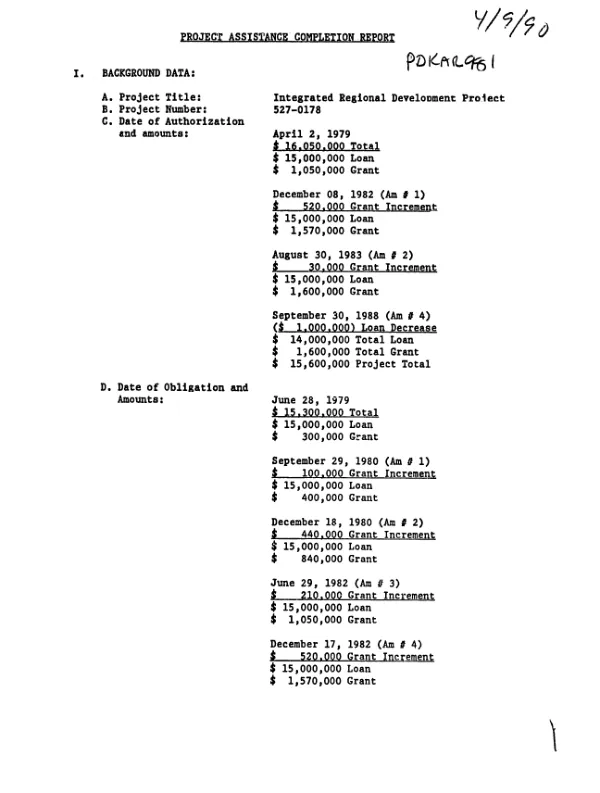
Project completion report : integrated regional development project
PACR of a pilot project (1979-1988) to support decentralized regional project planning and implementation and establish a funding mechanism for priority subprojects in market towns and rural areas in the Departments of Junin and Cajamarca.
1990
Sign in to readA free account is required to download.
Abstract
The project made respectable progress, and the processes of decentralization and administrative simplification are being implemented. Personnel trained by the project are working at different levels of the Government of Peru (GOP) and the private sector. Institutional strengthening/TA activities included: (1) establishment of TA and training programs within the Ministry of the Presidency (MIPRE) and National Institute for Municipal Development (NIMD); (2) a study of the issues involved in regionalization and administrative simplification, which resulted in the revision of legal provisions and norms governing programming and budgeting; (3) the provision of vehicles and machinery to Departmental Development Corporations (DDC"S) of Junin and Cajamarca; (4) the installation of microcomputers in four municipalities as demonstration models for other municipalities; and (5) provision of TA/training to all 24 DDC"s and 482 municipalities. The market town development component executed 38 activities benefiting 22,540 families, mainly by providing them with electricity, markets, slaughterhouses, and a trout processing plant. The component"s success is evident in the GOP"s establishment of a revolving fund for financing similar activities. Under the rural public works component, 99 activities were implemented for the benefit of 46,980 families, mainly through community highways, irrigation canals, and reservoirs. The major strength of this component was the high degree of local participation in selecting finance priorities, contributing resources, providing labor, and maintenance and repair. To further support community participation in development, promotion offices were established to organize community activities and provide training in such areas as community leadership, family planning, crop handling, crafts, agricultural marketing, and home economics. Several major lessons were learned. (1) Although Peru"s budgetary and administrative process is antithetical to decentralization, it is possible to create decentralized local development organizations by drawing almost exclusively on local human resources. Indeed, there is a strong rationale and basis for decentralized development in Peru. (2) Promoting rural development by strengthening rural-urban linkages in and around market towns is a viable development concept in Peru. (3) Municipalities are a critical source for mobilizing capital and human resources for development at a time when the central government has scant resources. (4) Local participation in project selection, planning, labor, and in-kind inputs is a vastly underutilized resource in rural Peru.
Related documents