USAID. MISSION TO PAKISTAN
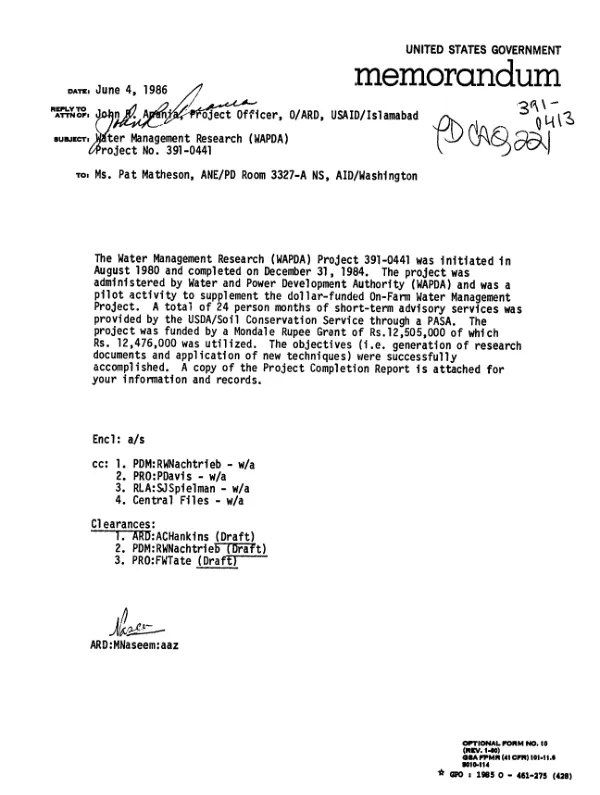
Project completion report : water management research project (WAPDA)
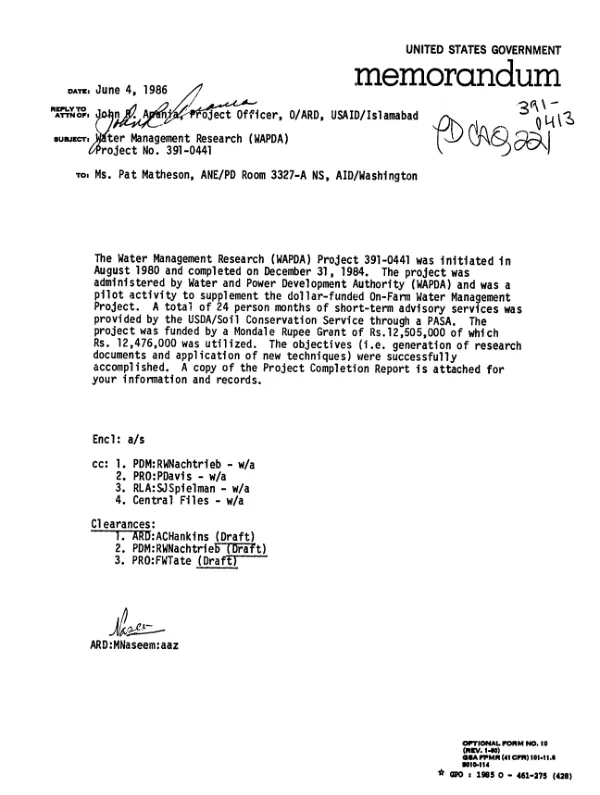
Provides final Mission report (8/80-12/84) on a pilot project, implemented by the Water and Power Development Authority (WAPDA) with help from the U.S.
1986
Sign in to readA free account is required to download.
Abstract
Department of Agriculture's Soil Conservation Service, to conduct water management research in Pakistan. Project targets for generating and publishing research documents and for applying new techniques and methodologies were met. The project completed 23 research studies in six different technical areas: watercourse improvement management; water, soil, and crop management; extension of water and crop management; economics of water and crop management; groundwater management; and tubewell operation, maintenance, and management. The studies, which were conducted both at the Mona Reclamation Experimental Station and on farmers' fields, received wide recognition and acceptance both within and outside of Pakistan. The most important research accomplishments were to increase official awareness of the problem of watercourse conveyance losses and to develop suitable techniques for reducing these losses. The project also evaluated field application losses and the effects of land leveling thereon, and established the fact that crops suffer from both over- and under-irrigation. Findings were disseminated to farmers through printed pamphlets in the Urdu language. As a result of such dissemination, the production of gypsum for use on saline, sodic soils has increased to more than 3,000 MT a day in Punjab, an indication that farmers are realizing the utility of gypsum for reclaiming saline soils. The project played a major role in developing the Water Management Research Component of A.I.D.'s Irrigation Systems Management Project. (Author abstract, modified)