ABT ASSOCIATES, INC.
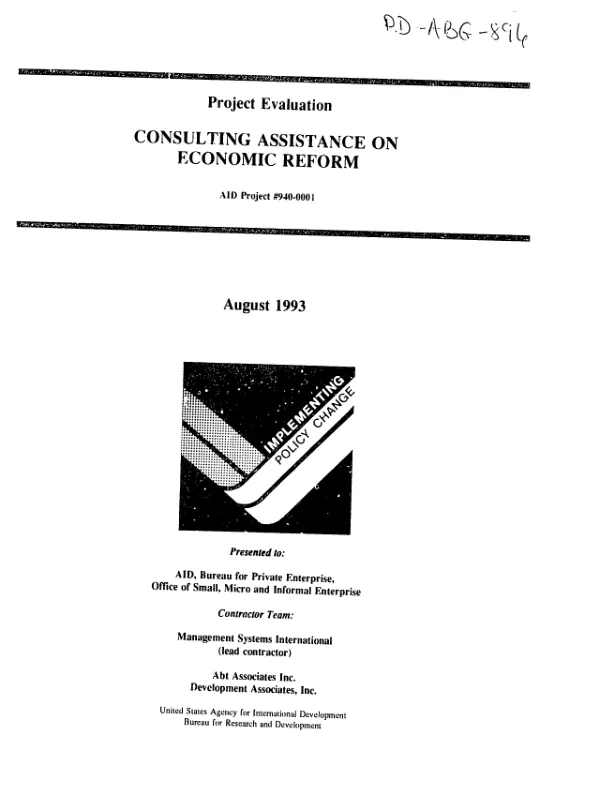
Project evaluation : consulting assistance on economic reform
Evaluates the Consulting Assistance for Economic Reform (CAER) project, designed to help A.I.D.
Callihan, David|Fields, Gary|Parker, Joan · 1993
Sign in to readA free account is required to download.
Abstract
and developing countries design, implement, and evaluate economic policy reform. Interim evaluation covers the period 7/89-6/93. At the time of the evaluation, 24 core and 51 buy-in activities had been completed. Illustrative efforts have included: identification of lessons from Asia's development experience applicable to Africa; a Costa Rica capital markets study; an examination of the social costs of macro-economic structural adjustment in Africa and Latin America; recommendations for Central Bank reforms in the Philippines; and a study on tax and pension reform in Hungary. Without question the project has achieved its objective of enhancing A.I.D.'s capacity to provide economic policy assistance to developing nations. The project has been well-managed by both A.I.D./PRE and the main contractor, the Harvard Institute for International Development (HIID); both have operated in a client-oriented and professional manner. The quality of work has been consistently excellent, probably because HIID has done an exceptional job of fielding high-quality TA teams. HIID has also developed useful publication series for disseminating project products, including the CAER Briefing Notes series and the CAER Discussion Paper series. Presentations have also been used effectively in conveying lessons learned to A.I.D. staff. The demand for buy-ins from A.I.D./W bureaus and USAID field missions has been greater than expected. This has kept the project's research agenda demand driven and has ensured that technical oversight remained within the funding bureau, two aspects which have enhanced the project's quality and responsiveness. One of the project's strengths has been its ability to serve as a quick-response mechanism for delivering clearly defined products through short-term TA. (There is no demand from the field for long-term TA.) It appears that the project has filled an important niche, both for applied analytic work for A.I.D./W bureaus and for TA to field missions. For many of its activities, the project has been the only logical contracting mechanism available. Given Harvard's stature, the project perhaps should be given a broader role in developing A.I.D.'s economic policy reform agenda. Other recommendations are to: increase dissemination activities; increase the funding ceiling for individual buy-ins, especially as there will likely be continuing demand for large buy-ins from the New Independent States and Eastern Europe; and explore ways to collaborate with related A.I.D. projects. (Author abstract, modified)
Related documents