ABT ASSOCIATES, INC.
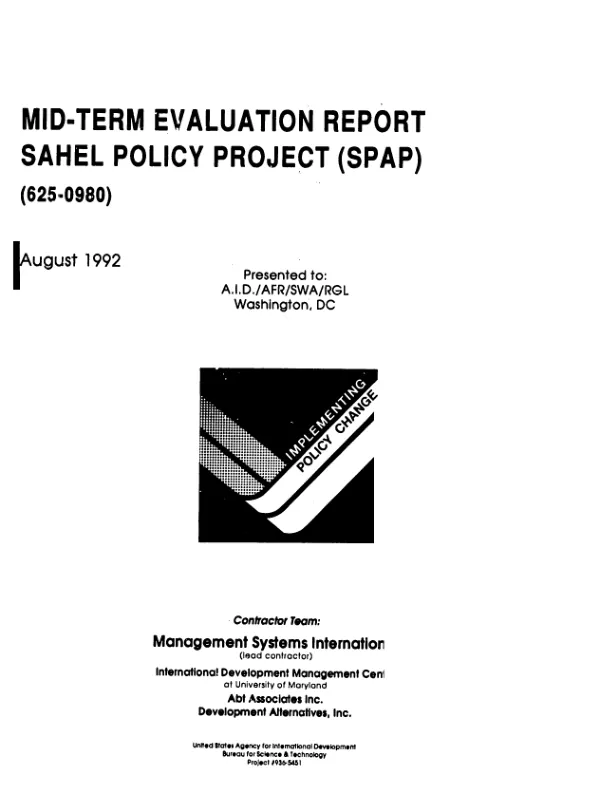
Mid-term evaluation report : Sahel policy project (SPAP) (625-0980)
The Sahel Policy Project (SPAP) was authorized in July 1985 with LOP funding of $8 million.
1992
Sign in to readA free account is required to download.
Abstract
Its goal was "to carry out a program of economic policy studies, advisory services, and training that will strengthen the bases for appropriate economic policy in the Sahel". Its PACD was extended in 1990 to September 1995, with no increase in LOP funding. It is a companion project to the Sahel Regional Institutions (SRI) Project (6250575), that provides support to the Permanent Interstate Committee for Drought Control in the Sahel (CILSS) and the Club du Sahel. Present LOP funding for SRI is $15 million under a 1990 Project Amendment. The relative proportions of SPAP"s components -- TA, studies, and training -- have changed over the LOP, with the emphasis after the 1990 PACD moving towards focused studies as Sahel Missions grew and had other options for TA. While earlier SPAP-funded TA and long-term study programs led to the development of country-level policy projects, efforts after the shift in emphasis increased the number and variety of studies available to further policy dialogue and deepen understanding of regional and subregional issues such as trade, environmental management, food security, decentralization, and finance, and to catalyze the activities of A.I.D. and other donors in these and other cross-sectoral areas. The evaluation team found that SPAP-funded activities have had both direct and indirect impacts on policy selection and implementation both at the national level in targeted countries, and at the regional level, through interaction with the CILSS and Club du Sahel secretariats, and the Sahel Institute. Leading examples are cereals marketing liberalization, marketing information systems, and broader economic policy reform in Mali; agricultural research improvement and environmental policy in Senegal; subregional livestock marketing reform; and private sector policy reform in the Sahel region and beyond. Using the SPAP project to buy into one or another centrally funded cooperative agreements with a land grant university or a non-university cooperator, A.I.D. Missions and the Sahel/West Africa (SWA) Office itself were highly successful in building up capacity and generating analytic products at the same time. From 1988 on, although Missions buy-ins were fewer, the SWA Office used SPAP as a mechanism for buying into centrally funded activities to fund studies and some shorter-term TA to address particular problems that had been identified within A.I.D. or through the Club and CILSS Secretariats. Recently, SPAP has served primarily to expand and reorient the policy analysis agenda at the regional level. This seems an appropriate evolution given the changing political and policy environments in the Sahel and West Africa as a whole. The team recommends that the project be extended, but combined with the SRI Project to reinforce the links between the policy analysis activities and other support to Sahelian institutions. (Author abstract, modified)
Related documents