USAID DEC
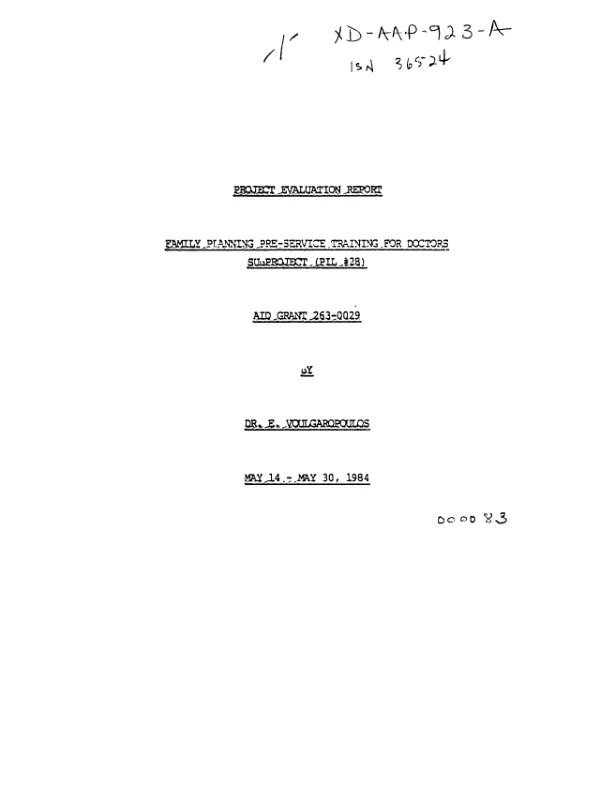
Project evaluation report : family planning pre-service training for doctors subproject (PIL #28)
Sign inUSAID. MISSION TO EGYPT
Project evaluation report : family planning pre-service training for doctors subproject (PIL #28)
Evaluates subproject (SP) to develop a family planning training and outreach program in Egypt for newly graduated physicians in ten Egyptian governorates.
Voulgaropoulos, E. · 1984
Sign in to readA free account is required to download.
Abstract
Special evaluation covers the period 8/81-5/84 and is based on document review, site visits, and interviews with USAID/E, University of Alexandria High Institute of Public Health (HIPH), and Government of Egypt (GOE) personnel and with trainees. Although the SP has developed training plans and educational materials, only 63 pre-service trainers from eight governorates (vs. a planned 240 from 10 governorates) have received two weeks (vs. a planned three) of Stage 1 family planning training at the Abbis II Health Center; a projected 80 will have been trained by the end of the project, only 33% of the target. Stage 2 training has been provided to 160 physicians in eight governorates by 29 of the pre-service trainers and 19 HIPH staff; Stage 2 output is expected to reach only 15-20% of the target. Training has been hampered by: (1) for the Stage 1 course, insufficient qualified trainees due to governorate-level staffing shortages, the GOE's failure to provide candidates, and the reluctance of physicians to leave private practices for the period required for Stage 1 training; and (2) for the Stage 2 course, the transfer of already-trained pre-service trainers, and inadequate governorate training facilities (and limited GOE funding for renovation or construction), training supplies, and equipment (e.g., pelvic models, films, slides). Although trainees report satisfaction with the training, its effectiveness has been handicapped by the inability of trainees to observe or practice IUD insertions on live patients. Finally, although a community family planning outreach program has been established at Abbis II, its application has been inconsistent, supervision by health center medical staff inadequate, and medical supplies chronically lacking. Lessons learned are the importance of direct and indirect host government support to project success and of basing design targets on a realistic assessment of available human resources and facilities. Several recommendations are given.