USAID. MISSION TO ETHIOPIA
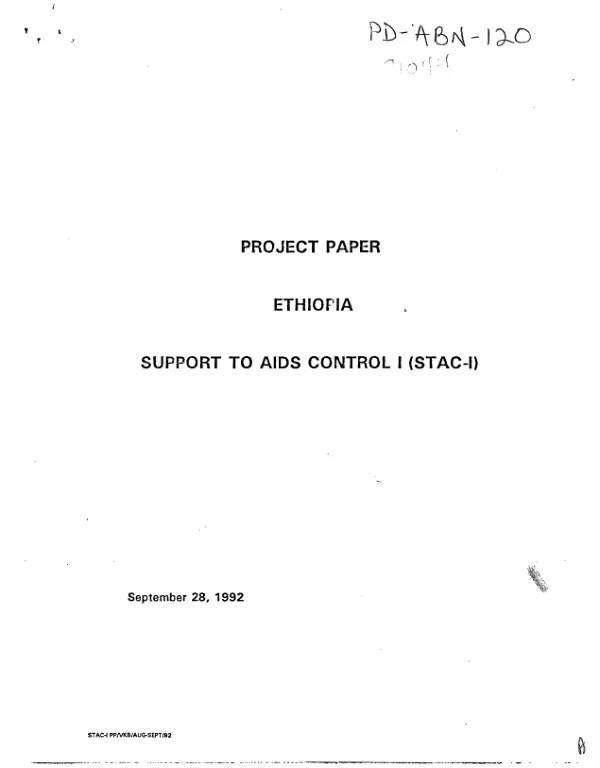
Project paper : Ethiopia -- support to AIDS control I (STRAC-I)
Project to strengthen institutions involved in the control of sexual transmission of HIV in Ethiopia, and to expand the scope of public and private interventions to do the same (STAC-I project).
1992
Sign in to readA free account is required to download.
Abstract
The project will be implemented by the Ministry of Health (MOH) and the National AIDS Control Program (NACP), and will consist of 6 components: STD prevention and control; IEC; condom social marketing; NGO/PVO involvement in HIV/AIDS prevention and control; behavioral research grants; and surveillance. Under the first component, STAC-I will strengthen and field test case management of HIV/AIDS. STAC-I will finalize and field test case management algorithms for STDS, which include all facets of patient management, laboratory support, and recommended drug treatments, as well as public health aspects. To accomplish this, STAC-I will provide TA to the NACP to complete biomedical research to identify the etiologies of common clinical syndromes and drug resistance patterns of the causative organisms. Also, the national central reference STD laboratory will be strengthened with technical and material support. The case management algorithms and service delivery will be pilot tested in 3 STD referral clinics in Addis Ababa and in 7 other new STD treatment units. Clinicians, nurses, health assistants, and laboratory technicians will receive training through the NACP, which will also develop the necessary training materials, including revised case management algorithms and counseling materials for provider and client. Physical facilities will be upgraded and provided with equipment and supplies. Secondly, STAC-I will support the NACP"s national school program of AIDS/STD education, which targets 7th and 8th grade students and which will expand to target 9th- and 10th-graders, by providing teacher training and supporting materials" development; the program will also be expanded from 93 schools to 200. In addition, STAC-I will support expansion of the Department of AIDS Control (DAC)"s Multiple Partner Sexual Contact (MPSC) program in 14 towns and its initiation/reinitiation in 8 towns; this program provides peer counseling to women with multiple partners. Support will consist of refresher training modules and materials" development, workshops, and assessments. Thirdly, STAC-I will procure approximately 9 million condoms, two-thirds of which will be allocated to Population Services International"s (PSI) Condom Social Marketing (CSM) effort and one-third of which will go to the NACP for free distribution. STAC-I will help strengthen PSI/CSM"s logistic systems (including data collection, storage, and distribution); and provide the NACP and PSI with management training, and transport and office support. Also, condom promotion will be expanded to the wider population through training programs, workshops, operations research, and TA for PSI and the NACP. Fourth, STAC-I will review existing NGO/PVO activities in HIV/AIDS control, and assess the potential for increasing NGO/PVO involvement. The assessment will recommend ways to enhance NGOs" work, including a grants program. STAC-I will consider using an umbrella organization such as Christian Relief Development Association (CRDA) or the Organization of Social Services for AIDS (OSSA) to administer the grants program. The grants program will be a pilot activity and support up to 15 NGO grants, not exceeding one year in effort. Under the fifth component, research institutions will receive grants to conduct HIV/AIDS-related behavioral research in collaboration with U.S. institutions. Under the sixth component, STAC-1 will improve the HIV/AIDS surveillance system and establish a surveillance system for sexually transmitted diseases (STDS). STAC-1 will provide short-term training abroad for one person and conduct national and regional training and supervision in data collection, modeling, and policy dialogue; assist the DAC"s epidemiologic unit to develop guidelines for the system; and strengthen 6 sentinel sites -- four for HIV and two for STDs, via training, supplies, and operations research.
![AIDS communications and technical services (ACTS) (supplement) [: amendment no. 1] -- phase two plan of activities](https://covers.devme.ai/gen/29655.webp)