USAID. MISSION TO ETHIOPIA
Support to AIDS control (STAC) project
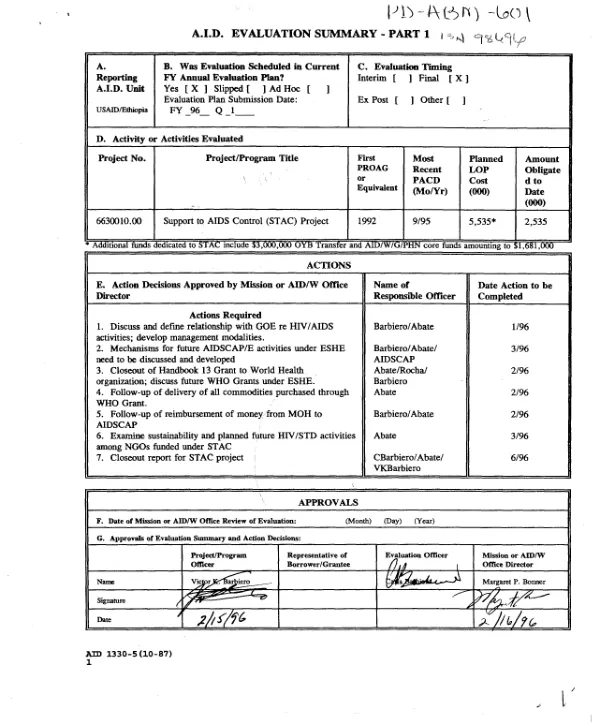
Summarizes final evaluation (PD-ABM-448) of a project (1992-9/95) to support public and private efforts to control AIDS in Ethiopia (STAC project).
1996
Sign in to readA free account is required to download.
Abstract
The project was implemented through a buy-in to the AIDSCAP project (9365972). The project had considerable success in achieving most of its planned outputs. It concentrated on providing integrated HIV/AIDS prevention and control activities at four focus sites (Awassa, Nazareth, Bahar Dar, Mekele) and Addis Ababa. These integrated activities included STD (sexually transmitted disease) case management at health centers and health stations, HIV/AIDS education in schools, condom social marketing, and community-based activities. Through focus site intervention teams (one of the project"s most successful innovations), collaboration between the public sector and NGOs was encouraged. In addition to the 4 focus sites, 16 peripheral clinical sites were strengthened in their capacity to diagnose and treat STDs. Nineteen of the clinical sites were renovated (the 20th should be renovated by 2/96), and a total of 11,804 STD patients were treated at the focus sites; steady growth in use of the focus sites suggests increased client confidence in the sites" ability to treat STDs. A total of 28 health personnel were trained in TOT (training of trainers) and STD management. All clinical personnel interviewed at the focus sites and at the peripheral clinical sites were aware of the advantages of STD syndromic management and were for the most part engaged in its application. IEC efforts made considerable progress. Anti-AIDS groups are now functioning in 36 schools and are estimated to have reached 86,000 students; three baseline Knowledge, Attitudes, Behaviors, and Practices studies of out-of-school youth have been conducted by NGOs, and more than 110,000 of these youth have subsequently been reached with IEC materials and activities developed by the NGOs; three materials development workshops were held, resulting in distribution of more than 300,000 copies of STD/IEC materials; and, in a significant achievement, more than 600 Multi-Partner Sexual Contacts (MPSCs) were trained as group leaders and IEC materials were distributed to more than 14,000 additional MPSCs. The condom social marketing program, which was implemented by Population Service International, exceeded all targets. The program established a management information system, set up 9,500 sales outlets and 9 regional satellite hubs, undertook an ambitious program of non-traditional IEC strategies to promote knowledge of AIDS and use of condoms, and sold more than 36.8 million condoms. To increase NGO/PVO involvement in HIV/AIDS prevention, the project awarded five large competitive grants (ca. $40,000 each), six mid-size grants (ca. $5-10,000 each), and seven small grants (ca. $1,000 each) via its Rapid Response Fund. It organized five workshops to develop NGO capacity in such areas as adult learning, evaluation, and target communication. Innovative NGO approaches to IEC (e.g., role playing, peer education, and pamphlets/posters, videos, and dramas focused on specific target groups) have reached 139,000 individuals. Despite the project"s best efforts, the impasse on behavioral research associated with establishing a working relationship with Addis Ababa University was not resolved, and this component was dropped in compliance with a recommendation of the mid-term evaluation to eliminate non-productive activities. However, in coordination with AIDSCAP, the project oversaw the completion of a targeted intervention research (TIR) study on community perceptions of STDs which provides guidance for future direction of Ethiopia"s STD control and prevention initiatives. Surveillance problems continue to hamper Ethiopia"s ability to accurately estimate the extent of HIV/AIDS. However, the project has potentially strengthened surveillance by building the technical capacity of regional and health facility staff, who in turn should provide sufficient for support localized surveillance initiatives. Although the planned orientation of health center staff in biohazardous waste disposal and in prevention of HIV transmission in the health care setting has been delayed, staff are sensitive to these issues. The following lessons were learned. (1) Much of the project"s success may be attributed to the high degree of collaboration between USAID/E and AIDSCAP/E, between the central and regional levels of the Ministry of Health, and among the GOE, USAID, and WHO. (2) Future projects would benefit from increased attention to the importance of administrative and management planning and support for logistics and materials development. Subsequent project designs should pay increased attention to the importance of impact analyses for selected initiatives, such as those involving capacity building of NGOs. (3) The importance of innovation is the paramount lesson of this project, a lesson which was clearly demonstrated in the formation of interdisciplinary focus site intervention teams, in the use of selected MPSCs to serve as group leaders in promoting condoms among an acknowledged high-risk group; and in the enthusiasm and imagination shown by NGOs which that employed peer educators to deliver compassionate but clear messages on the need to change high-risk behaviors.