USAID DEC
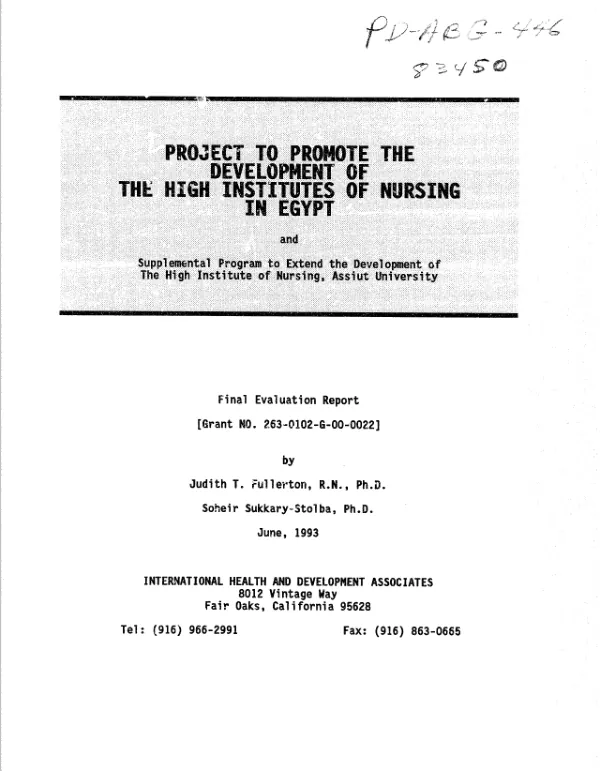
Project to promote the development of the High Institutes of Nursing in Egypt and supplemental program to extend the development of the High Institute of Nursing, Assiut University
Sign inINTERNATIONAL HEALTH AND DEVELOPMENT ASSOCIATES
Project to promote the development of the High Institutes of Nursing in Egypt and supplemental program to extend the development of the High Institute of Nursing, Assiut University
Final evaluation of project (1/90-6/93) to promote the development of university nursing education in Egypt by establishing a consortium of High Institutes of Nursing (HINs).
Fullerton, Judith T.|Sukkary-Stolba, Soheir · 1993
Sign in to readA free account is required to download.
Abstract
The project was implemented by Project HOPE. Despite the problems noted below, the project made remarkable progress in improving the status and image of nurses in Egypt. A strong HIN Executive Board has been established, facilitating communication among the Institutes. The project has also succeeded in establishing Demonstration Clinical Units (DCUs), each linked to either a hospital or primary health care facility; many of the DCUs will be sustained through local efforts beyond the life of the project. The development of written nursing standards is another significant contribution, and one which required a great deal of effort. Sharing of educational resources and technical expertise help newly established HINs develop their junior faculty; consultants from well-established HINS were hired to assist the faculty of new HINs. In addition, project workshops helped raise consciousness about nursing issues in Egypt; junior faculty stated that they use workshop information in conducting in-service training for other health care providers. U.S. training of HIN Directors, DCU Coordinators, and physicians encouraged professional growth, facilitated collegiality between HIN Directors and physicians, and enabled some HIN Directors to network with U.S. nurses. Problem areas included: (1) lack of clarity regarding the roles of HIN Directors, status of the Executive Board (advisory vs. policymaking), management practices, and rules and regulations; (2) lack of clarity about project inputs among HIN Directors, who expected more up-to-date books, equipment, etc; (3) overly ambitious and unrealistic objectives, which should have been refocused at the time of mid-term evaluation; and (4) problems in overall communication between Project HOPE staff and some HIN directors. A team-building workshop would have helped clear the air and created a better working environment. The following lessons were learned. (1) In projects where major institutional changes are desired, a great deal of attention should be given to the formation of Advisory/Executive Boards consisting of representatives from all relevant policymaking organizations. (2) Project policies, rules, and regulations governing the status and the relationship between cooperating organizations have to be clearly identified, formally articulated, and disseminated among members of participating organizations. (3) The success of a curriculum development initiative depends to a large extent on the amount of human resources, TA, time, and money allocated to the effort. (4) The development of a set of nursing standards is crucial for the success of a project which aims at improving the image of nursing. If these standards are significantly to determine the quality of nursing, they should be enforced and updated as needed. Follow-on projects to sustain the project's achievements and extend HIN influence into secondary/technical nursing education are recommended.