USAID DEC
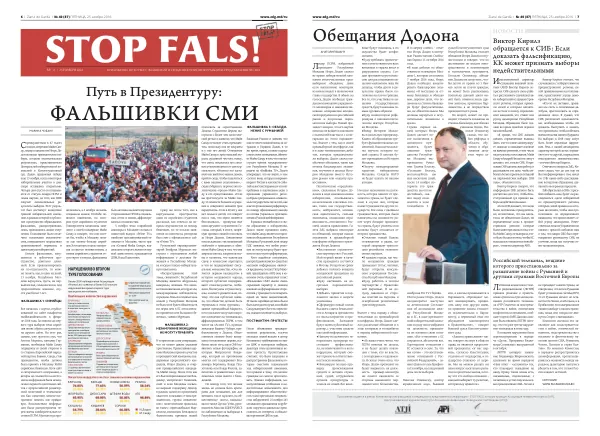
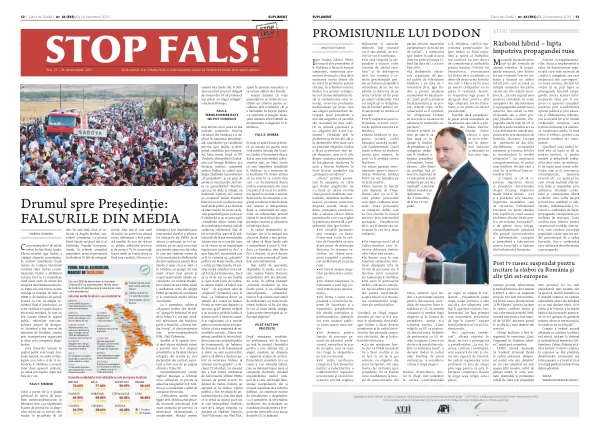
Promisiunile lui Dodon
The presidential election in Moldova was won by Igor Dodon, the leader of the Socialist Party of the Republic of Moldova (PSRM), with a margin of 67,000 votes over Maia Sandu, the leader of the Democratic Party of Moldova.
2016 · 1 pages
Sign in to readA free account is required to download.
Abstract
Dodon's victory was celebrated on November 13, 2016, despite some polling stations in the diaspora remaining open. Four days later, Dodon renounced his position as leader of the PSRM and party member, before the Central Election Commission (CEC) officially announced the final results of the election. The election was marred by a dirty campaign, with numerous false information and misinformation spread in the public space, as well as attempts to denigrate opponents. The election was also marked by attempts to commit fraud, including organized transportation of voters and even bribery of voters. One of the false information campaigns was centered around the claim that Angela Merkel, the Chancellor of Germany, had promised Maia Sandu her support and that of the European People's Party. According to this claim, Sandu would receive 30,000 Syrian refugees in Moldova if she were to become president. Although the website that initially published this information was a satirical one, it was quickly picked up by numerous pro-Russian websites and TV stations, and was later spread through newspapers and electoral leaflets of the PSRM. Igor Dodon, the newly elected president of Moldova, made numerous promises during his campaign, including the restoration of strategic partnership with Russia, the return of Moldovan products to the Russian market, and the holding of early parliamentary elections. He also promised to initiate a referendum on Moldova's foreign policy vector, to introduce the study of Moldovan history in schools, and to work closely with the Orthodox Church. However, many of these promises were criticized by experts and analysts, who pointed out that they were not within the president's competence or authority. For example, the president cannot unilaterally adopt laws or make decisions on the country's foreign policy. The president can only propose laws to the parliament, which must then adopt them. Nicolae Osmochescu, a former judge at the Constitutional Court and a doctor of law, criticized Dodon's promises, saying that they were populist and unrealistic. He pointed out that the president cannot unilaterally cancel exams, introduce new laws, or make decisions on the country's foreign policy. All these decisions must be made by the parliament, which is the supreme legislative body in Moldova. Osmochescu also criticized Dodon's promise to work closely with the Orthodox Church, saying that the church is a separate institution from the state and that the president cannot interfere in its affairs. He pointed out that the church is a private institution that is free to make its own decisions, and that the president cannot dictate its policies. In conclusion, the Moldovan presidential election was marked by a dirty campaign, with numerous false information and misinformation spread in the public space. The election was also marked by attempts to commit fraud, including organized transportation of voters and even bribery of voters. The newly elected president, Igor Dodon, made numerous promises during his campaign, but many of them were criticized by experts and analysts as being populist and unrealistic.
Related documents