USAID. BUR. FOR POLICY AND PROGRAM COORDINATION. CENTER FOR DEVELOPMENT INFORMATION AND EVALUATION (CDIE)
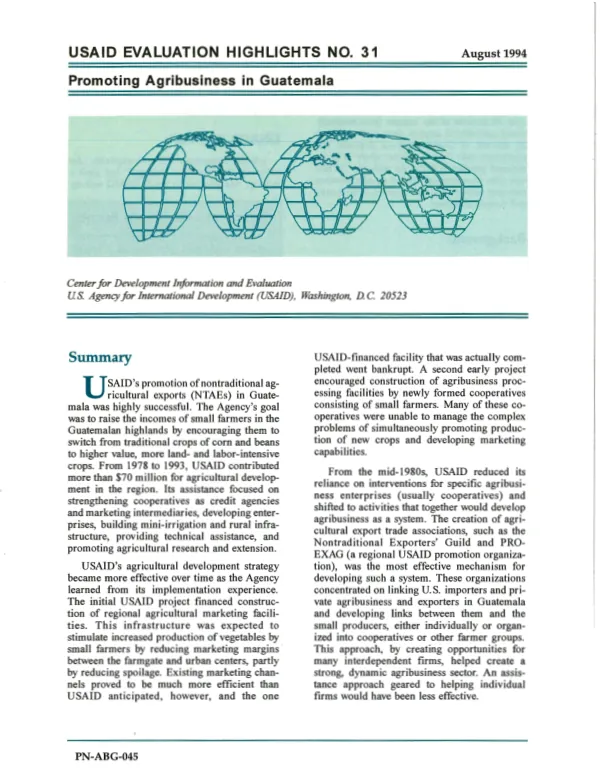
Promoting agribusiness in Guatemala
From 1978 to 1994, USAID contributed $70 million through four umbrella projects to promote nontraditional agricultural exports (NTAEs) in Guatemala.
1994
Sign in to readA free account is required to download.
Abstract
The higher-value, labor- and land- intensive NTAEs were designed to increase productivity and create jobs, thus addressing both scarcity of foreign exchange and skewed income distribution. USAID"s approach was directed towards the altiplano, where the poorest Guatemalans reside, focused on crop diversification, and supported the development and strengthening of producer cooperatives as the preferred means for marketing the new crops. The projects had several impacts. They contributed to the growth of new agribusiness firms while benefiting existing firms, improved the regulatory environment for exports, rapidly expanded both exports and employment, provided substantial benefits for the poorest Guatemalans, and yielded a 20% economic rate of return on USAID"s investment. Although USAID failed in its objective to strengthen cooperatives, the NTAE sector as a whole has good prospects for continued growth. On the negative side, the movement to NTAEs has increased agrochemical use, leading to concerns about pesticide residues and land degradation. The following lessons were learned. (1) The most effective mechanism for promoting agribusiness in Guatemala was to help agribusiness as a sector, rather than helping individual firms. (2) USAID was wrong to assume in 1978 that the marketing structure in Guatemala was inefficient and that it could "modernize" that structure with relative ease. (3) All NTAE crops increased the income of the poor, though some did so much more than others. (4) Contract farming -- in which processors provide growers with credit and technical assistance in exchange for fixed-price delivery of the harvest -- has considerable potential for raising small farmers" incomes.