USAID DEC
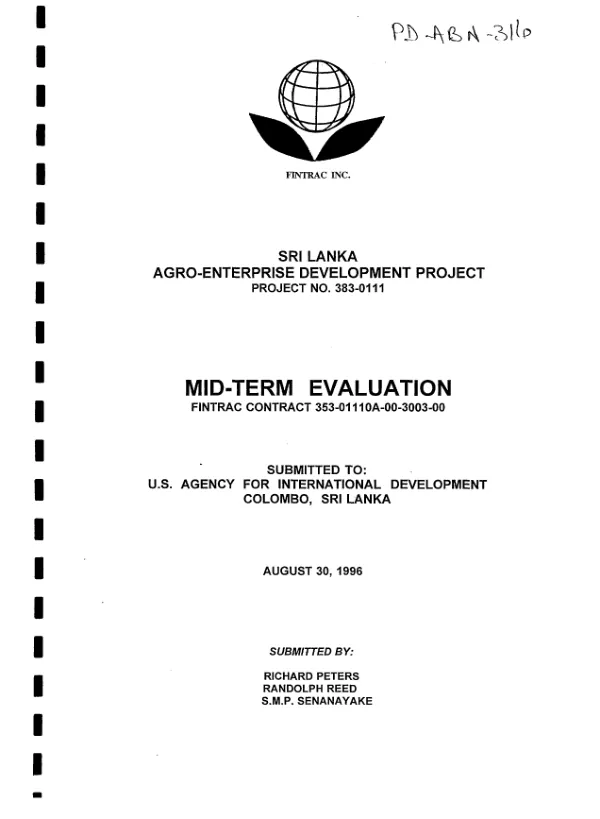
Sri Lanka agro-enterprise development project -- project no. 383-0111 : mid-term evaluation -- FINTRACT contract 353-0111-A-00-3003-00
Sign inFINTRAC, INC.
Sri Lanka agro-enterprise development project -- project no. 383-0111 : mid-term evaluation -- FINTRACT contract 353-0111-A-00-3003-00
Evaluates project to stimulate the expansion of private agro-based enterprises in Sri Lanka (AgEnt project).
Peters, Richard|Reed, Randolph|Senanayake, S. M. P. · 1996
Sign in to readA free account is required to download.
Abstract
Mid-term evaluation covers the period 5/92-8/96. AgEnt has made good progress, and by its completion date of 9/98 it is projected to achieve $32 million in investment (vs. a targeted $20 million) and directly or indirectly generate 21,365 new jobs (vs. a targeted 13,000). It is important to note that these accomplishments will be made without a significant component originally envisaged for the project: the $6 million World Bank Agro-Enterprise Investment Fund. The project has devoted considerable resources to developing new varieties and crops in hope that some will prove profitable and provide new opportunities for Sri Lankan farmers. It is too early to tell whether this has happened. Nonetheless, interviews with 30 AgEnt customers show that most greatly appreciate AgEnt's assistance. AgEnt has obtained its best cost/benefit results in terms of additional investment and sales in poultry, processed foods, piggery, spices and essential oils, aquaculture, and floriculture. In terms of job creation, the most dynamic sectors include piggeries, processed foods, spices and essential oils, vanilla, floriculture, and maize. AgEnt should consider placing higher priority on sectors with low cost-to-benefit ratios. Some sectors, such as poultry and ornamental fish, will probably continue to experience high growth without AgEnt assistance. In these sectors and when working with large clients, AgEnt should emphasize impacts on employment or on leadership needed to spread an activity. Policy, production, and marketing constraints will continue to adversely affect agribusiness unless they are addressed. AgEnt has been making good progress in the latter two areas, but needs to do more in the area of policy. The evaluation notes that service delivery can be improved through a radical reorganization of AgEnt, and includes recommendations for accomplishing this. AgEnt's sustainability plan envisages the formation of an Agricultural Development Trust comprised of a Services Unit and a Production Holding Company for investment. The Services Unit would generate some income from fees and commissions, but without donor funding would face an uphill battle in achieving sustainability. The Production Holding Company, in which AgEnt plays a more active management role and takes equity positions, shows more promise of eventually generating enough revenue to cover costs. The following lessons were learned. (1) Although traditionally risk-averse, Sri Lankan farmers respond well to growing a product which is profitable and has a stable market. Prominent examples of success include the outgrowers for the poultry and ornamental fish industries. (2) In sectors which depend upon the Government of Sri Lanka (GSL) for protection from competition, there is always the chance that the GSL will change policy abruptly. (3) AgEnt needs to explore opportunities for value-added processing. In some instances, such as gherkins, the fresh product is not competitive on the international market, but could become so after local processing. (4) Quality is a necessary but not sufficient condition for developing a successful product. Packaging and labeling are just as important. This is clearly demonstrated in AgEnt's good work with a small spice producer. (5) Project design should not assume that another donor will contribute the resources necessary to achieve project goals. For example, the $6 million World Bank Agro-Enterprise Investment Fund failed to materialize. Similarly, it would be a mistake to assume that another donor will provide an endowment to help institutionalize AgEnt beyond the year 2000.
Related documents