USAID DEC
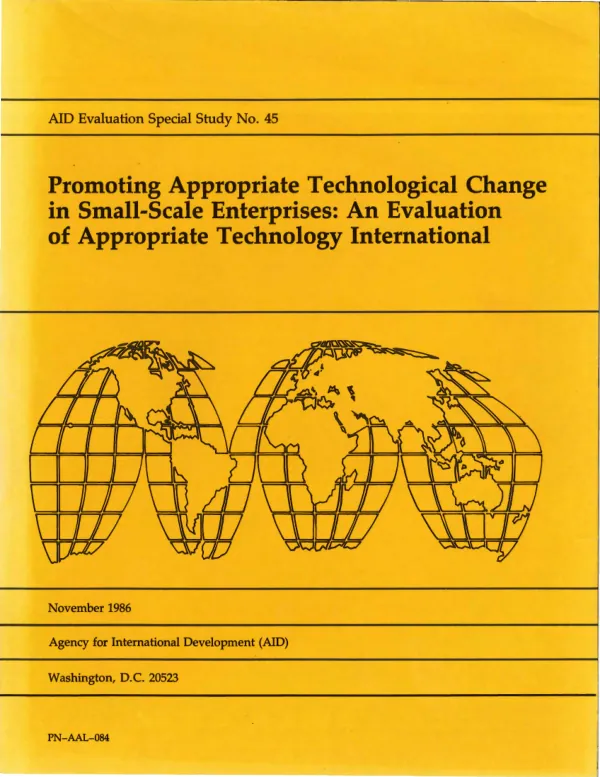
Promoting appropriate technological change in small-scale enterprises : an evaluation of Appropriate Technology International's role
Sign inDEVRES, INC.
Promoting appropriate technological change in small-scale enterprises : an evaluation of Appropriate Technology International's role
Appropriate Technology International (ATI), a private, nonprofit development assistance organization, was created through a 1976 Congressional mandate to experiment with and develop new approaches to technology development and transfer.
Delp, Peter|Velasquez, Antonio|Ulsaker, Norman|Halvorson, Raundi|Turner, Allen|Van Blarcom, Bonni J.|Foster, Michele · 1986
Sign in to readA free account is required to download.
Abstract
This evaluation study, based on field visits to ATI projects, analyzes ATI's success to date. ATI's unique role in economic development assistance - to link appropriate technology and small-scale enterprise development within an experimental learning framework - is inherently risky. Thus, it is not expected that each ATI project will be successful. Still, ATI has met all quantifiable performance indicators under its current cooperative agreement with A.I.D., and its overall capacity to plan and implement projects has grown steadily (though not without accompanying weaknesses). The direction, quality, and impact of its technology development activities have also in general improved, although ATI's concentrated attention on the replication of hard technologies has diminished other important aspects of its mission, particularly the development and transfer of innovative soft technology. Projects under the cooperative agreement have not yet matured enough to provide many benefits to the poor. With regard to project planning, ATI has significantly improved its technical and commercial appraisals, although further refinement and more consistent application are needed for the latter. More careful attention to market analysis and the assessment of implementing organizations' capabilities is also needed. ATI's field management allows for a responsive, flexible working style, which, however, has the disadvantage of weakening ATI's ability to learn from its experience; lessons learned have not been systematically identified and disseminated. Monitoring and evaluation systems should be revised and integrated with planning and field supervision. Some aspects of the A.I.D. system and in particular its oversight role impede attainment of ATI objectives; also, better communications with Missions are needed. Finally, although A.I.D. financial support is declining, ATI has not yet succeeded in finding other funding sources.
Related documents
Documents in this collection
 1986
1986USAID DEC
Promoting appropriate technological change in small-scale enterprises : an evaluation of Appropriate Technology International"s role
Open record 1992
1992USAID DEC