USAID. BUR. FOR POLICY AND PROGRAM COORDINATION. CENTER FOR DEVELOPMENT INFORMATION AND EVALUATION (CDIE)
Promoting primary education for girls in Pakistan
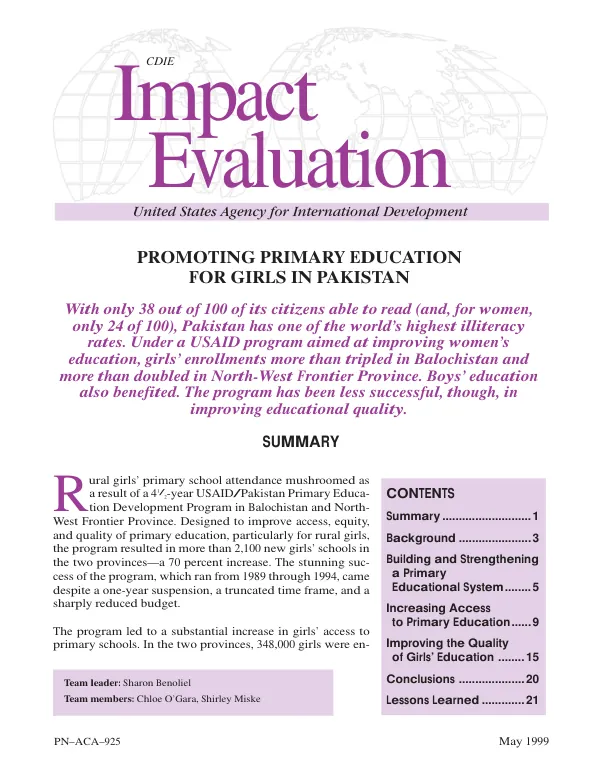
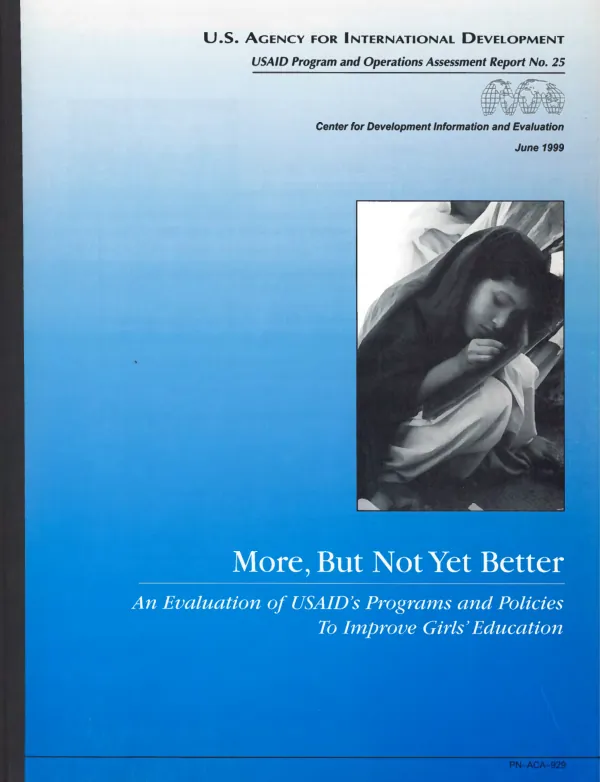
Despite a 1-year suspension, a truncated time frame, and a sharply reduced budget, USAID"s Primary Education Development (PED) program (1989-94), designed to promote access to primary education, particularly for rural girls, in Pakistan"s North-West Frontier Province (NWFP) and Balochistan Province, was a stunning success.
Benoliel, Sharon; O"Gara, Chloe +1 more · 1999
Sign in to readA free account is required to download.
Abstract
PED increased the number of girls" schools by 2,100 (a 70% increase), as well as girls" access to primary schools from 348,000 in grades 1-5 in 1989 to 761,300 in 1996. Boys" enrollment also increased over that period, from 1.3 million to 1.6 million. PED achieved the rapid gains in primary school participation by negotiating policies that developed and strengthened new primary institutions and supported new programs. Three strategies were especially effective: (1) communicating one clear goal -- enrolling girls in primary school; (2) opening more schools for girls through construction grants and innovative strategies such as the Community Support Program and promotion of "fellowship schools" (private urban nonformal schools for girls) in Balochistan and "genderless" schools in NWFP; and (3) recruiting and training more female teachers for rural schools. At project end, counterparts repeatedly bemoaned the loss of USAID"s leadership, which was characterized by long-term active engagement, policy dialogue, clear direction without micro-management, technical savvy, and strategic systems thinking. On the negative side, policy discussions about school quality were minimal. Program initiatives were hampered by the absence of a shared vision of what quality education should look like and who was responsible for making it happen. Nonetheless, there were some notable programmatic achievements, including: a phonetic approach to teaching Urdu, the national language, incorporated in the national curriculum; improved instructional materials in both provinces; extensive teacher training using condensed versions of existing training programs; and achievement testing in NWFP. However, the sustainability of PED achievements faces several threats. These include the continued poor quality of girls" classroom experiences, the large number of communities still needing the assistance of NGOs to organize parent education committees, fast-growing populations, scarce financial resources, and the lack of role models and opportunities for educated girls. Lessons learned are as follows: (1) Commitment to educating girls, communicated consistently by diverse leaders through multiple channels to a wide range of audiences, appears to have been critical to broad increases in girls" education. (2) Goal-centeredness facilitates decentralization, community participation, and innovation. The latter two are probably necessary to achieve the shifts in social norms required to change practices related to gender roles in traditional societies. (3) Without incentives for change, a program approach in an unchanged policy environment may not have a systemwide impact on the quality of education. (4) Policy emphasis on quality might have helped institutionalize quality improvements, thereby fostering the sustainability of PED gains in girls" access to schooling. (5) Unrealistically high standards for teacher and student achievement do not lead to better performance, but reinforce notions that girls are not capable and contribute to patterns of high dropout and repetition rates. (6) Gender discrimination distorts supply and demand and limits the effectiveness and efficiency of strategies for system reform. Policy and program actions that require changes in gender role norms reduce these distortions. (7) Initiatives like the Community Support Program demonstrate a three-way partnership between villagers, NGOs, and government that empowers more stakeholders, facilitates innovation, and minimizes deadlock better than do two-way government-community partnerships.
Related documents
![Ecuador NFE [non-formal education] project : literacy"s rainbow twenty-five years later](https://covers.devme.ai/gen/37535.webp)