USAID DEC
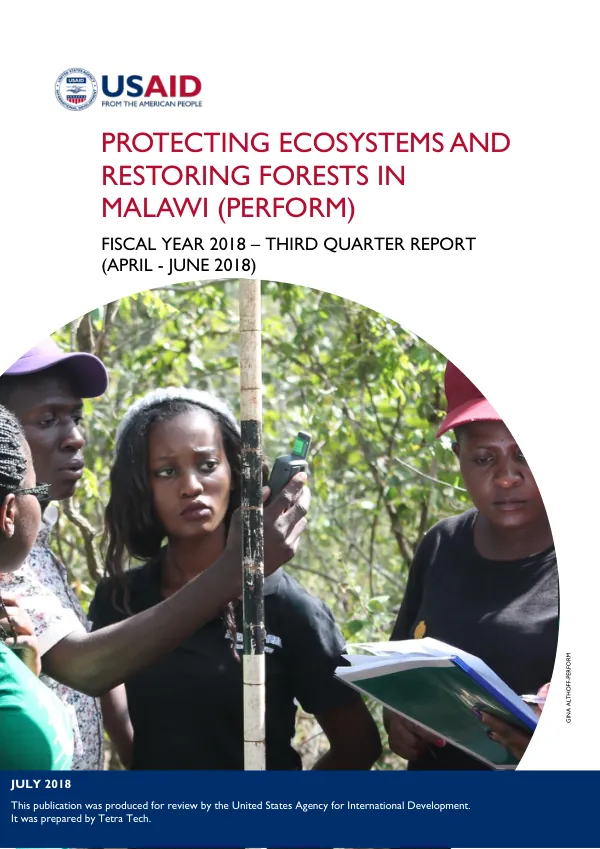
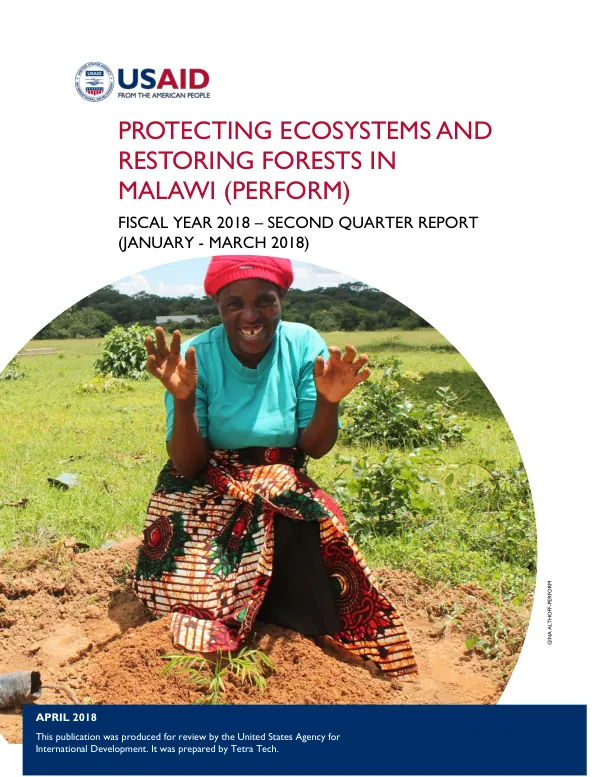
Protecting Ecosystems and Restoring Forests in Malawi (PERFORM) Fiscal Year 2018 – Second Quarter Report
Sign inGOVERNMENT OF MALAWI
Protecting Ecosystems and Restoring Forests in Malawi (PERFORM) Fiscal Year 2018 – Second Quarter Report
The Protecting Ecosystems and Restoring Forests in Malawi (PERFORM) project aims to advance REDD+ readiness, increase low-emissions land use opportunities, improve low-emissions development capacities, institute pathways for sustainability, and advance CDCS priorities of integration and institutional strengthening.
2018 · 26 pages
Sign in to readA free account is required to download.
Abstract
The project's goal is to help Malawian institutions and communities conserve forests and promote green growth, contributing to the United States Agency for International Development (USAID) Malawi CDCS goal of improving Malawians' quality of life. The contractual period of performance for the PERFORM project began on September 2, 2014, and will end on September 1, 2019. This report documents project implementation in the 2nd quarter of Fiscal Year 2018 (January 1, 2018 – March 31, 2018). The project's objectives are to advance REDD+ readiness, increase low-emissions land use opportunities, improve low-emissions development capacities, institute pathways for sustainability, and advance CDCS priorities of integration and institutional strengthening. During the 2nd quarter of Fiscal Year 2018, PERFORM supported the Department of Forestry (DoF) in presenting the revision of the Forestry Act (1997) to the Malawi Parliamentary Conservation Caucus. Based on feedback received, PERFORM worked with the DoF and the Ministry of Justice to draft a proposed Forestry Act Amendment, which was formally submitted by the DoF to the Ministry of Justice on March 23rd. PERFORM also completed the Forest Management Plan for the Chikangawa Forest Reserve, which is a critical step in implementing sustainable forest management practices. The plan outlines strategies for forest conservation, sustainable forest products, and community engagement. Additionally, PERFORM supported the development of a Forest Co-Management Plan for the Chikangawa Forest Reserve, which aims to promote collaborative management between the government and local communities. In terms of low-emissions land use opportunities, PERFORM supported the development of a Conservation Agriculture (CA) project in the Chikangawa Forest Reserve. The project aims to promote sustainable agricultural practices, reduce deforestation, and increase crop yields. PERFORM also supported the establishment of a Community-Based Forest Management (CBFM) project in the Chikangawa Forest Reserve, which aims to promote community-led forest management and conservation. PERFORM's efforts to improve low-emissions development capacities included the development of a Greenhouse Gas (GHG) inventory management system for the Government of Malawi. The system aims to provide accurate and reliable data on GHG emissions, which will inform policy and decision-making. PERFORM also supported the development of a Low-Emission Development Strategy (LEDS) for Malawi, which aims to promote sustainable development and reduce GHG emissions. In terms of pathways for sustainability, PERFORM supported the development of a Public-Private Partnership (PPP) framework for the forestry sector in Malawi. The framework aims to promote collaboration between the government, private sector, and civil society organizations to promote sustainable forest management and conservation. PERFORM also supported the establishment of a Forest Certification Scheme for Malawi, which aims to promote sustainable forest management and certification of forest products. Overall, PERFORM's efforts in the 2nd quarter of Fiscal Year 2018 have contributed to the advancement of REDD+ readiness, low-emissions land use opportunities, low-emissions development capacities, pathways for sustainability, and CDCS priorities of integration and institutional strengthening in Malawi.