USAID DEC
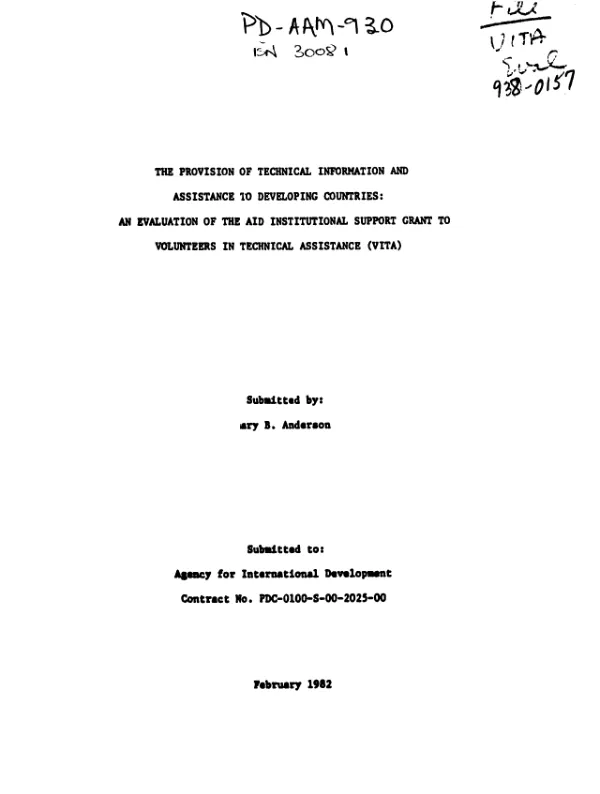
Provision of technical information and assistance to developing countries : an evaluation of the AID institutional support grant to Volunteers in Technical Assistance (VITA)
Sign inUSAID DEC
Provision of technical information and assistance to developing countries : an evaluation of the AID institutional support grant to Volunteers in Technical Assistance (VITA)
Evaluates project to support efforts of Volunteers in Technical Assistance (VITA) to provide technical information to LDC's.
Anderson, Mary B. · 1982
Sign in to readA free account is required to download.
Abstract
Special evaluation covers the period 9/78-2/82 and is based on document review, interviews with VITA and A.I.D. personnel, and three visits to Honduras. The A.I.D. grant helps VITA perform a unique service and meet specific needs that would otherwise not be met. VITA's Inquiry Service has received an increasing number of requests each year (all of which are answered), the majority (77% in 1981) of them from LDC nationals. Evaluation forms returned by VITA clients show the Service's value to users, especially in terms of speed and efficiency. During site visits the evaluator observed a number of pieces of equipment and/or techniques adapted from VITA publications and documents and visited a complete documentation center in Tegucigalpa which utilzies VITA materials. VITA has trained LDC nationals in opening highly successful indigenous documentation centers. Internally, VITA has established a well-run program for its 3,700 volunteers and has developed successful internal monitoring and document and records management systems. However, a few problem areas were noted. Many volunteers, while fully committed to their work, believed they are underutilized by VITA. Gender bias was noted in VITA literature and presentations, with only men portrayed as beneficiaries of VITA assistance and little done to target women as an audience. As most VITA clients are literate and technically able, the poor and illiterate are for the most part not directly reached by VITA. Although response time to requests has been steadily reduced, fewer individualized responses have been sent. Prepackaged responses are most often remitted, the generality of which does not always meet clients' specific needs. Other problems are the lack of local language materials and the poor quality of some of the documents remitted. It is recommended that A.I.D. continue to provide institutional support to VITA (including funding for VITA publications if copyright issues can be settled) and explore with VITA ways to pursue technology transfer at the individual level. VITA is urged to redress the difficulties noted above.
Related documents