USAID DEC
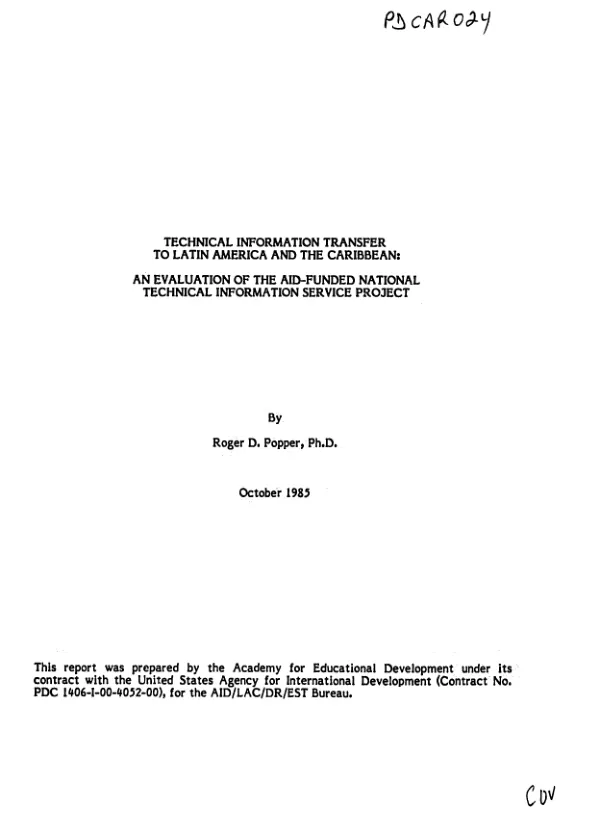
Technical information transfer to Latin America and the Caribbean : an evaluation of the AID-funded National Technical Information Service project
Sign inACADEMY FOR EDUCATIONAL DEVELOPMENT, INC. (AED)
Technical information transfer to Latin America and the Caribbean : an evaluation of the AID-funded National Technical Information Service project
Evaluates project to provide Latin American and Carribbean countries with access to U.S.
Popper, Roger D. · 1985
Sign in to readA free account is required to download.
Abstract
National Technical Information Service (NTIS) products and services. External evaluation covers the period 1981-84 and is based on site visits and interviews with project personnel and beneficiaries. Results have been mixed. The project has succeeded in encouraging private sector use of NTIS. About 54% of users are small to midsize businesses looking for practical solutions to problems caused by, e.g., excess manufacturing capacity. It is estimated that each $100,000 of technical information services results in 100 private sector applications, of which 50 are of the "hands on" variety. On the negative side, product costs, language and technology problems, and lack of aggressive marketing strategies have kept the project from achieving targets to increase volume of sales, achieve self-sufficiency, and expand its range of services. NTIS' potential for disseminating large amounts of technical information remains unfulfilled because of a drop in demand for services due to devaluation of local currencies during 1981-84. NTIS document pricing (prices are high even without a strong dollar) has further complicated the problem of generating large sales of a product (highly technical documents written in English) which is necessarily of interest to only a select group of customers. Further, document delivery time is slow, and in-country NTIS network agencies have little incentive to actively promote the products (marketing to A.I.D. Missions and projects is particularly weak). As a result, hopes for self-sufficiency are impossible to meet. The project receives a 6-16% return on the dollar in the countries on which it focuses, and 22-38% over the entire region. Efforts to strengthen in-country network agencies have met with only moderate success; more private sector agencies should be included. Plans to expand the project's range of services have been only partially fulfilled as the necessary technology is just now arriving in Latin America and the Caribbean. For example, both on-line access and CARINET electronic mail service for document ordering depend on telecommunications with packet switching, which is available only in limited areas of Costa Rica, Honduras, and Panama. Similarly, document sales would be boosted by the use of low-cost, reliable fiche to paper printers, which are only now coming onto the market. The NTIS project will require subsidy if it is to continue. This approach should be taken if A.I.D. is convinced that the project can effectively promote technology transfer with positive economic impacts and/or promote the sale of U.S. products and services (including information products and services).
Related documents
Documents in this collection
 1985
1985USAID DEC
Technical information transfer to Latin America and the Caribbean : an evaluation of the AID-funded National Technical Information Service project
Open record 1985
1985USAID DEC