USAID DEC
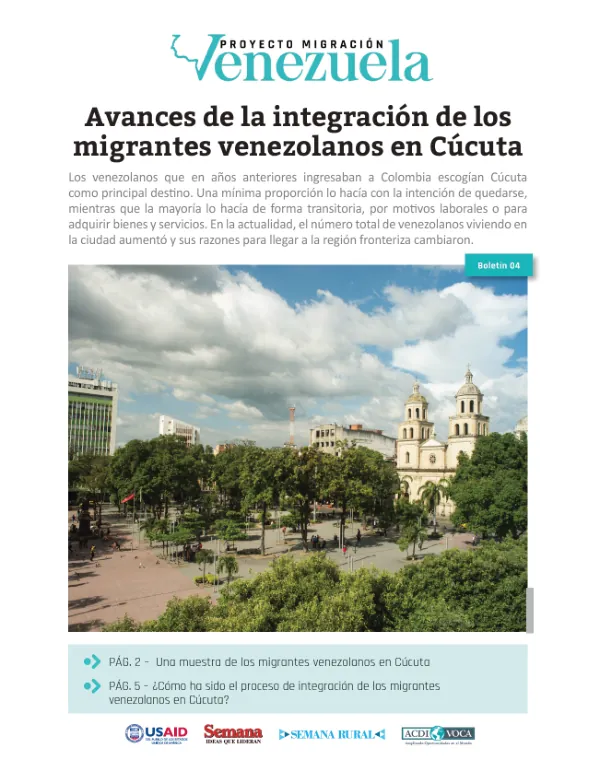
Proyecto Migracion Venezuela: Integración de los migrantes venezolanos en Cúcuta
The integration of Venezuelan migrants in Cúcuta, Colombia, has been a complex process.
8 pages
Sign in to readA free account is required to download.
Abstract
Initially, Cúcuta was a hub for pendular migration, with Venezuelans traveling back and forth between the two countries. However, as the situation in Venezuela worsened, many migrants opted for permanent residence in Colombia. Despite some planning to return to Venezuela when conditions improve, the majority require access to basic services to improve their living conditions in Colombia. Upon entering the country, Venezuelan migrants seek access to essential goods and services such as housing, healthcare, education, and employment. However, they often face discriminatory treatment due to their nationality. A significant proportion of migrants, 54.5%, reported feeling rejected, primarily in public spaces (70.3%) and when seeking employment (87.3%). This perception is crucial for Cúcuta, as the city faces significant economic and social development challenges. Cúcuta has a high poverty rate, with 36.2% of the population living below the poverty line in 2018. The city also experiences high levels of unemployment (17.4% in February 2019) and informality (69.8% of employed individuals in February 2019). Many Venezuelan migrants rely on family and friends already living in Cúcuta for housing, with 50% of respondents indicating that they initially stayed with these connections. However, accessing a permanent residence is perceived as difficult by 68.6% of the migrant population. The education system is another area of concern, with 70.5% of respondents indicating that their children are not currently studying. The primary reasons cited are insufficient income to cover educational costs (64.5%) and lack of necessary documents (25.8%). Despite the government's decision to provide free education to Venezuelan children in April 2018, many migrants face barriers in accessing this service. The labor market presents a complex scenario for Venezuelan migrants. The majority engage in activities unrelated to their previous experience in Venezuela, and 84.8% do not practice their profession due to lack of permits. This underestimates the potential of migrant labor, as they face challenges in validating their qualifications. A significant proportion, 93%, have not been able to validate their titles, with 21.6% citing lack of necessary documents from the Venezuelan government and 11% considering the process too costly. Despite 72% of respondents having engaged in an income-generating activity in the previous month, 93% perceive it as difficult or very difficult to access employment. This may be related to the fact that 55.4% lacked the necessary permits to work. The majority, 83.8%, work independently without a contract, primarily in informal commerce and a small proportion in general services.
Related documents