USAID. MISSION TO INDONESIA
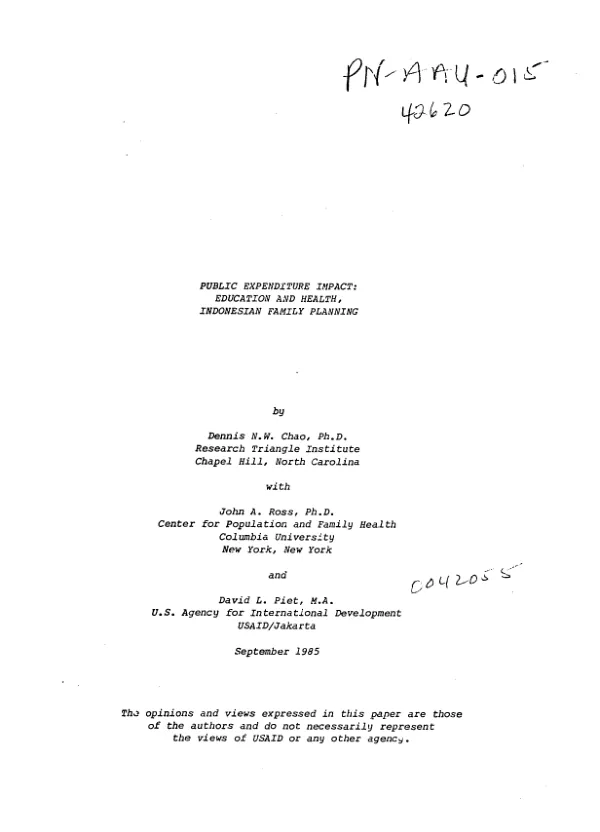
Public expenditure impact : education and health, Indonesian family planning
The potential impact of Indonesia"s widely hailed family planning program on public expenditures for health and education is analyzed in this paper.
Chao, Dennis N. W.; Ross, John A. +1 more · 1985
Sign in to readA free account is required to download.
Abstract
Analysis was both retrospective and prospective, covering the period 1971-2001, and was made using two projections, one recognizing the potential effect of the program, the other assuming that there is no program in place. It was found that the program would avert 73.7 million births over 30 years, and thus would reduce health expenditures by Rp. 337 billion in the year 2001 alone and result in cumulative savings of Rp. one trillion in education expenditures. The total effect of the family planning program on government expenditures for health and education is to lower spending by 9% in 1981, 38% in 1991, and 41% in 2001. Although program costs exceed savings in the early years, net savings become positive in 1979 and continue to increase rapidly. Even projecting a more limited family planning program, the internal rate of return would be very significant (31%).
Connected topics
![Analisys [analysis] of health financing in Indonesia -- 1982-1986](https://covers.devme.ai/gen/46345.webp)