USAID DEC
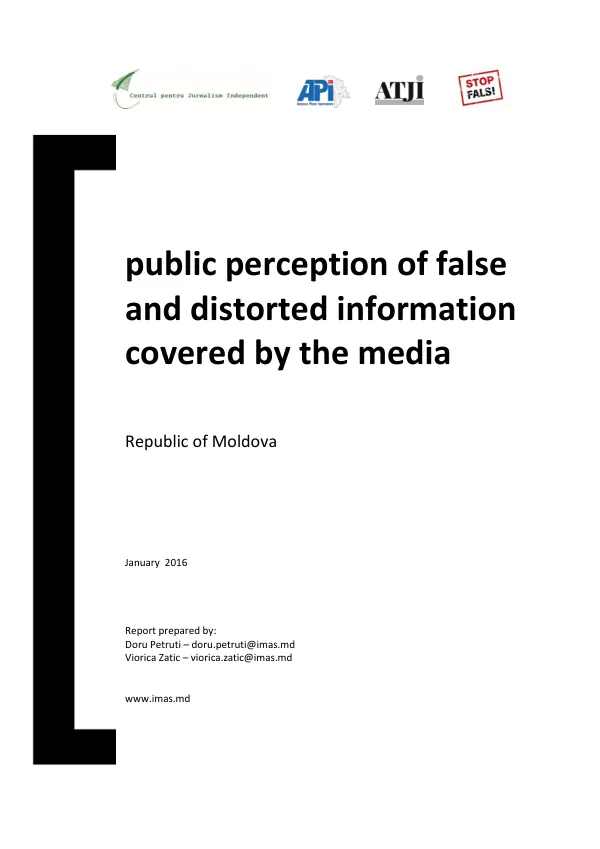
Public Perception of False and Distorted Information Covered by the Media in Republic of Moldova January 2016
Sign inASSOCIATION OF INDEPENDENT PRESS
Public Perception of False and Distorted Information Covered by the Media in Republic of Moldova January 2016
The public perception of false and distorted information covered by the media in the Republic of Moldova is a significant concern.
2016 · 49 pages
Sign in to readA free account is required to download.
Abstract
According to a report prepared by the Institute of Marketing, Analysis, Surveys and Investments "IMAS" in January 2016, a majority of respondents (56%) stated they were dissatisfied with the lack of responsibility of the national media. Only 8% of respondents believed that the media in Moldova exhibit a responsible behavior toward their audiences to a very large extent. The majority of respondents (65%) cited television as their preferred source of social and political news, followed by the Internet (24%), and social networking sites and radio stations with 5% each. However, opinions are divided on self-perception of capacities and skills needed to determine whether a media material is manipulative or propagandistic, with 51% of the surveyed thinking that they would be able to deal with this issue, while 47% feeling rather unprepared to face this phenomenon. Respondents rated political debates on TV channels (46%) and TV news bulletins (44%) as susceptible to providing false information to a large and very large extent. Even online platforms, such as the Internet (29%), social networking sites (26%), and blogs (24%), are perceived to provide false information on social and political issues to a large extent. However, it is worth noting that more than a third of the respondents do not use online media platforms. The manipulation technique perceived as most often used by media outlets is "selection of topics, which are convenient for the chief of the institution," with 32% of respondents saying that this occurs almost always, and 37% saying this occurs often. Other forms of manipulation, such as "lie by omission" (60%), "manipulative use of expert opinions" (58%), and "sensational headlines" (64%), are also commonly perceived as being used by media outlets. The study found that men aged 30-44 years old, with higher education levels and living in urban areas (especially in municipalities), are more aware of perceiving manipulation techniques to a significantly large extent. This is because they are more interested in political information, follow it more often, and address it more critically than women. The report also highlights that nearly three-quarters of respondents said they were familiar with the concept of manipulation, but the responses varied depending on demographics and social factors. For example, the older or less educated a person was, the less likely was s/he to respond positively to knowing this term. Similar results apply to respondents who were unemployed and spent more time at home. The study concludes that the public perception of false and distorted information covered by the media in the Republic of Moldova is a significant concern, and that media outlets are perceived to use various forms of manipulation to influence public opinion.
Related documents