USAID. MISSION TO PHILIPPINES
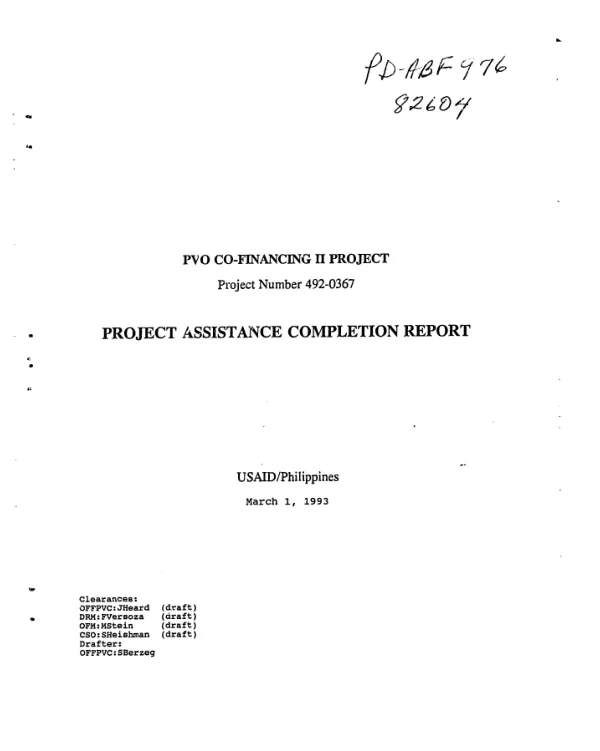
PVO co-financing IV
Project, follow-on to 4920345, -0367, and -419, to support PVO efforts in the Philippines.
1992
Sign in to readA free account is required to download.
Abstract
The project will: (1) strengthen the capacity of established PVOs to serve as intermediate institutions (IIs) helping smaller PVOs to provide basic services and expand employment; (2) broaden support to hard-to-reach indigenous PVOs, especially those serving ethnic and religious minorities; and (3) strengthen PVO coordination and advocacy. The major share of project funds will be directed through block grants to increase the capacity of IIs to finance subprojects by smaller PVOs. The project will also attempt to leverage PVO access to commercial credit for enterprise development and income-generating projects. Since Philippine law requires commercial banks to reserve a portion of their loan portfolios for small business lending, the project will present a proposal to select banks to establish an investment fund for use by businesses, community development organizations, and community credit cooperatives in low-income areas. If commercial funds can not be leveraged, the investment fund will be created with community and other non-A.I.D. resources. Potential clients will receive training and TA to help them qualify for the loans. This component will also provide administrative and technical training to increase the number of PVOs that qualify as IIs; the target is to establish five new IIs, at least one to represent ethnic minorities. In addition, free-standing and special-purpose PVOs will receive direct funding for subprojects. All told, the project will support 40-50 subprojects in income generation, housing, health care, sanitation, and natural resource management; 18-24 of these will be aimed at ethnic minority populations. A second project component will make a concerted effort to increase the number and diversity of indigenous PVOs, especially those representing ethnic and religious minorities in remote areas, e.g., those inhabiting southern Mindanao, the Sulu Archipelago, and parts of Luzon and the Visayas. An assessment of PVOs operating in such areas will be undertaken early on to determine the extent to which the needs of these communities for basic services are being met. Finally, the project will channel funds through IIs to strengthen PVO networks and their capacity to share information and strategies with community organizations, private enterprises, and local government units in a wide variety of development efforts, including potable water, sanitation, health care, credit, employment, agrarian reform, and disaster prevention, mitigation, and preparedness. This component will also help local PVOs form an umbrella organization (most probably under the aegis of the PVO association PINOI) to support advocacy and policy dialogue initiatives and serve as a PVO clearinghouse. A computerized database will be developed to provide PVOs a quick and gender-sensitive source of information. IIs will also orient the three regional training centers developed under -419 toward enterprise development and PVO advocacy. Training provided at these centers under the project will focus on credit management, project management, adult education and literacy, community organization, basic health services, microenterprise development, disaster management, and entrepreneurial training.
Related documents