INTERNEWS
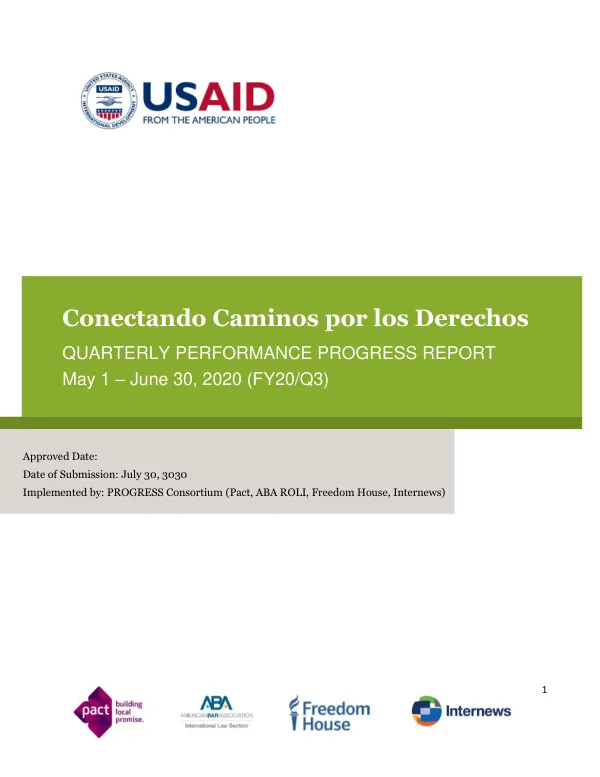
Quarterly Performance Progress Report: Conectando Caminos por los Derechos (CCD)
Colombia's Human Rights Support Mechanism (HRSM) is a four-year program led by Freedom House, with the goal of promoting and protecting human rights in Colombia.
2020 · 13 pages
Sign in to readA free account is required to download.
Abstract
The program, Conectando Caminos por los Derechos, aims to improve citizen security and community cohesion in migrant communities in Colombia by preventing human rights violations, strengthening human rights, responding to human rights violations, and responding rapidly to changing circumstances and needs in the context of mixed migration flows and shocks. The program is implemented by the PROGRESS consortium, including Pact, the American Bar Association Rule of Law Initiative (ABA ROLI), Freedom House, and Internews. The program prioritizes human rights that populations in migrant communities are currently most vulnerable to, including labor exploitation, sexual exploitation, human trafficking, human trafficking, and gender-based violence. The program's implementation began on May 1, 2020, and marked the start of the six-month Inception Period, which aimed to establish a foundational understanding of the contextual environment and priority technical areas, forge working relationships with diverse stakeholders, and establish a sound and flexible approach that fits the requirements of the local context. During the first two months of implementation, a team of members from all implementing partners, as well as Bogotá and Medellin-based staff, came together to start up processes and necessary documentation for the program. By June 30, all USAID deliverables required within the first 60 days were submitted on time and approved, representing timely compliance with USAID contractual obligations. The program's implementation was affected by the COVID-19 pandemic, which resulted in restrictions to travel and in-person meetings. The CCD team used virtual tools and platforms to maintain team cohesion and progress, focusing on identifying information, brainstorming ideas, and laying the ground for a unified vision. Key initial meetings were held with government counterparts and other strategic partners, providing a platform to identify common priorities and delineate cooperation in the protection, prevention, and response to human rights violations of migrants, returnees, and receptor communities. The program prioritized a meeting with Gerencia de Fronteras and set up meetings for the following quarter with the Ministry of Interior, the Ombudsman's Office, the Office of the Advisor for Human Rights, and the Inspector General's Office. Meetings were also held with national and local civil society organizations, and work began to refine the scope of work with proposed partners, including Centro de Investigación y Educación Popular (CINEP), DataSketch, and Colombia Check. The program onboarded the Chief of Party, Grants and Operations Manager, Communications Officer, and Human Rights Protection Lead, and start dates were finalized for the Deputy Chief of Party and Gender Equality and Social Inclusion (GESI) Advisor. Interviews were also underway to hire other key positions, including the Monitoring, Evaluation, and Learning (MEL) Manager and technical leads. The program developed an initial framework for the Rapid Response Fund (RRF), which will ensure timely response to current challenges faced by migrants, returnees, and receptor communities, while allowing for quick wins to position the program in the human rights and migration context and establish trust with target communities, institutions, and institutions. The program's context is characterized by quarantine measures and COVID-19-related restrictions to movement, which remain the most significant challenges for the program's start-up. The degree of access to stakeholders and communities will be restricted and will vary by location, with some degree of mobility expected in Cúcuta and Riohacha, but heavy restrictions in Maico and by locality in Bogotá. The humanitarian, human rights, and human rights situation in Venezuela continues to deteriorate, forcing rising numbers of Venezuelans to attempt to flee. The program is adapting to conditions described under Scenario Two in the Inception Period Approach, in which stakeholder engagement and primary source data collection will be conducted mostly through remote means, and in-person consultations with key stakeholders will be pushed towards the end of the Inception Period, as local conditions permit. As of June 2020, there were 1,788,380 migrants reportedly in Colombia, 57% of which had an irregular status and 54% of which were in CCD's target municipalities, with Bogotá being the largest recipient. The COVID-19 pandemic has presented incredible country-wide challenges, with cities experiencing total or near-total quarantines and mobility restrictions and intensity care units reaching full capacity.