GLOBAL COMMUNITIES
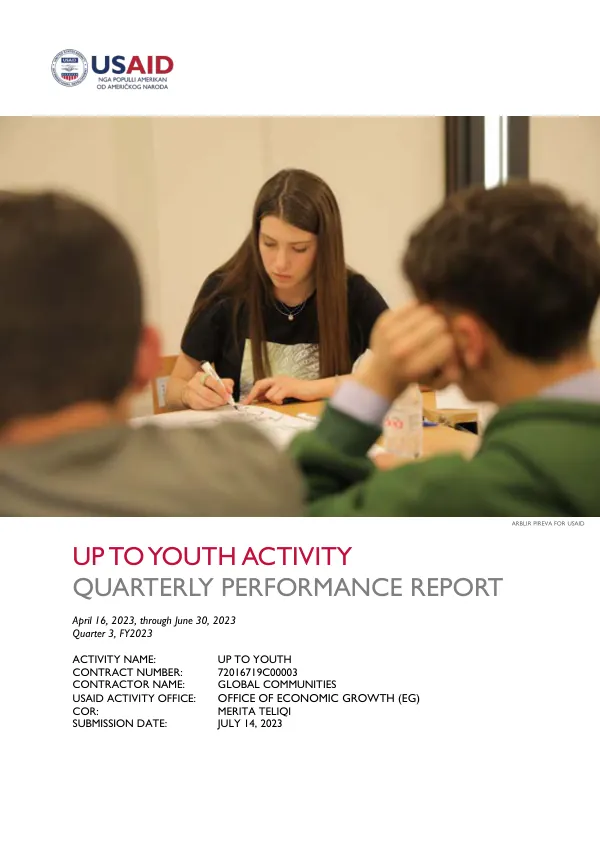
Quarterly Performance Report for Up to Youth Activity
The Up to Youth Activity is a five-year initiative implemented by Global Communities in partnership with LINC LLC, Moonshot CVE, Peer Educators Network, and LENS, with a contract value of $8,937,089.
2023 · 26 pages
Sign in to readA free account is required to download.
Abstract
The activity aims to address youth vulnerable to social exclusion by mobilizing and engaging them in meaningful ways to effect positive change, thereby increasing their resilience to social exclusion and violent extremism. The Up to Youth Activity targets youth aged 15 to 24 years old, broken into cohorts of 15 to 18 years old and 18 to 24 years old, focusing on both in-school and out-of-school youth with age-appropriate activities. The initiative emphasizes working with marginalized youth, particularly those underserved by current and past youth-focused initiatives, grappling with unaddressed stress and trauma, or vulnerable to developing risky behaviors. Vulnerability characteristics include extreme poverty, exposure to gender-based violence and other violence, lack of employment, non-majority ethnic status, and trouble in school. The activity applies an evidence-based approach to youth learning, equipping youth with the skills they need to demonstrate agency in leading community asset mapping, analyzing data to identify youth-related challenges or priorities in their community, and working with other youth and local stakeholders to design and implement solutions such as advocacy campaigns, community initiatives, and social ventures. By empowering youth to use data and analysis, and to leverage and engage their support networks and government, youth vulnerable to social exclusion will make informed, effective contributions to their communities. The Up to Youth Activity has three interconnected and mutually reinforcing objectives, grounded in a Positive Youth Development (PYD) approach: Objective 1, Mobilize Youth to be forces for positive change; Objective 2, Develop and demonstrate life/soft skills among youth; and Objective 3, Develop, build, and support resilience partners in fostering an environment for youth to engage in a positive and meaningful way. The activity is implemented in nine municipalities, grouped into three geographic clusters. The approved municipalities and clusters include: Cluster 1, consisting of municipalities A, B, and C; Cluster 2, consisting of municipalities D, E, and F; and Cluster 3, consisting of municipalities G, H, and I. During the first quarter of Year Five, the activity made significant progress in meeting or exceeding expected targets at the individual youth level. Staff engaged youth in all nine municipalities and continued to serve the original cohorts of approximately 479 youth. In addition, staff began orienting and training the 440 youth in the newly recruited cohort. Activities in all three objectives continued to meet or exceed expected targets. Objective 1, Mobilize Youth to be forces for positive change, focused on identifying, recognizing, and bringing together vulnerable youth who have the potential and will to contribute to positive change. The activity completed a workshop for the third cohort of the Youth Advisory Board, covering a range of subjects, including Objectives, Audiences, Strategy, Implementation, and Scoring (OASIS), and Do No Harm (DNH). Objective 2, Develop and demonstrate life/soft skills, gave youth skills to become changemakers in their communities and to engage in the local and national economy. The activity held 11 tolerance training sessions with the Youth Advisory Board and existing cohorts, and nine critical-thinking and social media training sessions with the newly recruited cohorts. The activity also welcomed additional 154 youth to the trainings through the "Bring your friend" campaign. Objective 3, Develop, build, and support resilience partners, focused on identifying formal and informal stakeholders who can serve as youth resilience partners, strengthening the existing networks of these stakeholders, and building new ones. The activity strengthened Youth Support Networks' role and improved operational support, updating and finalizing their membership roster in all three Clusters, and implementing YSN activities supported under SCF third-round initiatives in each of the nine municipalities.
Related documents