DEVTECH SYSTEMS, INC.
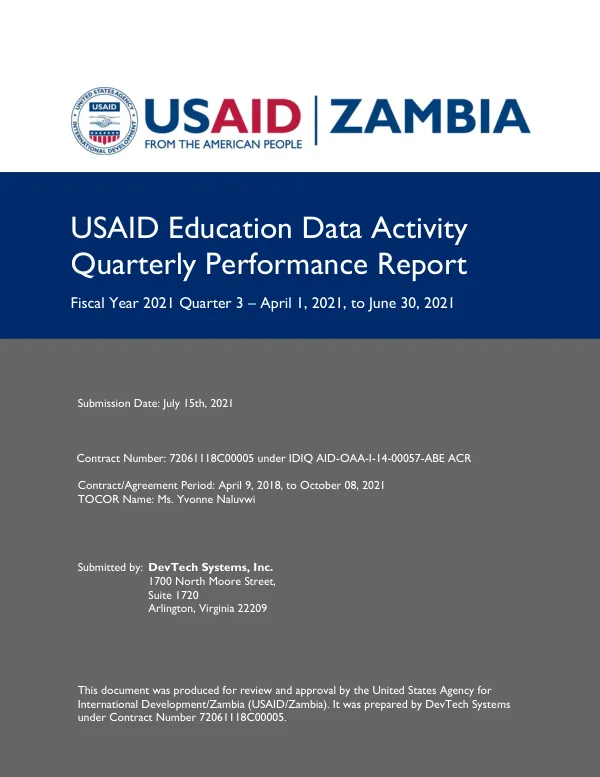
Quarterly Performance Report: USAID Education Data activity April-June 2021
The USAID Education Data Activity is a program aimed at providing distinct assessment, data management, and research and evaluation services to monitor and track the progress of USAID's Let's Read Project bilateral activity.
2021 · 31 pages
Sign in to readA free account is required to download.
Abstract
The program is implemented by DevTech Systems, Inc. under Contract Number 72061118C00005, with Management Systems International (MSI) and Khulisa Management Services (Pty) Ltd. as subcontractors. The program's goal is to strengthen the capacity of the Examinations Council of Zambia (ECZ) to independently conduct Early Grade Reading Assessments (EGRA) in the future to inform policy-level decisions aimed at improving learning outcomes. The program's objectives include completing two large-scale EGRA assessments (baseline in 2018 and midline in 2021), strengthening the capacity of ECZ to conduct EGRA, and conducting research on topics agreed upon with USAID and in collaboration with the Ministry of General Education (MoGE). The program targets 4,250 schools in 56 districts in 5 provinces and 4,113 schools in 53 districts in 5 additional provinces. The target beneficiaries are Grade 2 learners and ECZ staff. During the reporting period from April 1, 2021, to June 30, 2021, the program faced significant challenges due to the COVID-19 pandemic, which led to school closures and a lack of in-person interaction. As a result, the program focused on alternate implementation methods adapted for a virtual context. Despite these challenges, the program made significant progress, including the selection of the National Estimates Research Study (NERS) sample and the submission of the Sampling Methodology Report. The program also created a Steering Committee to embed with ECZ and commenced the dissemination of findings from the Early Childhood Education (ECE) baseline study. The program's implementation progress was affected by the COVID-19 pandemic, which led to delays in implementation activities. However, the program adapted to the new context and continued to make progress on its objectives. The program's collaboration with MoGE and ECZ was crucial in achieving its objectives, and the program's ability to adapt to the changing context was essential in ensuring the continuation of its activities. The program's key highlights during the reporting period include the selection of the NERS sample, the creation of the Steering Committee, and the dissemination of the ECE baseline study findings. These achievements demonstrate the program's commitment to its objectives and its ability to adapt to challenging circumstances. The program's continued collaboration with MoGE and ECZ will be essential in achieving its objectives and ensuring the sustainability of its activities. The program's geographic coverage includes 9 provinces in Zambia, with a target population of 8,363 schools and 1.3 million Grade 2 learners. The program's target beneficiaries are Grade 2 learners and ECZ staff, who will benefit from the program's research and evaluation services. The program's reporting period is from April 1, 2021, to June 30, 2021, and the program's next reporting period will cover July 1, 2021, to September 30, 2021. The program's procurement of a local survey firm to assist with logistical and administrative implementation is a significant achievement, as it will enable the program to continue its activities despite the challenges posed by the COVID-19 pandemic. The program's ability to adapt to the changing context and continue its activities is a testament to its commitment to its objectives and its ability to work effectively in challenging circumstances. The program's collaboration with MoGE and ECZ is crucial in achieving its objectives, and the program's ability to adapt to the changing context is essential in ensuring the continuation of its activities. The program's continued progress on its objectives will be essential in ensuring the sustainability of its activities and the achievement of its goals.