USAID DEC
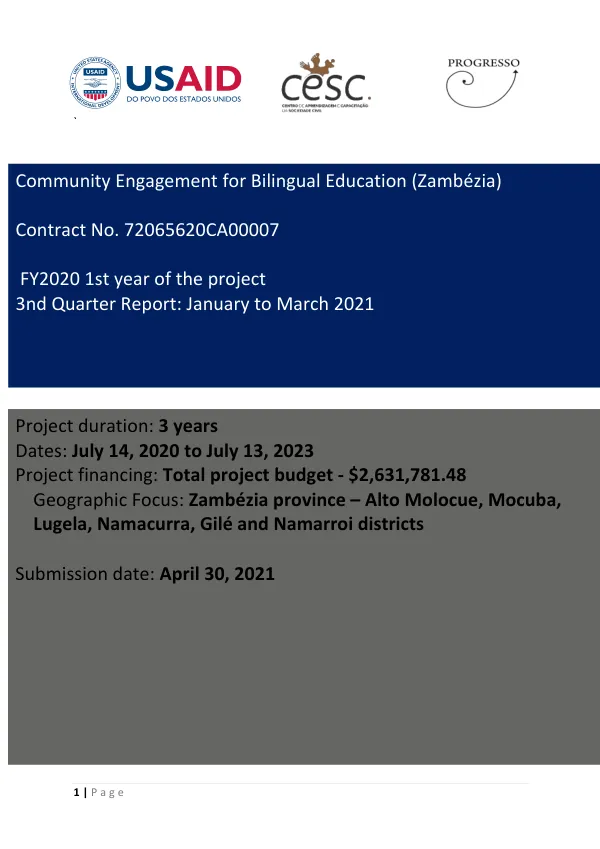
Community Engagement for Bilingual Education (Zambézia) Quarter Progress Report Jan-Mar 2021
Sign inUSAID DEC
Community Engagement for Bilingual Education (Zambézia) Quarter Progress Report Jan-Mar 2021
The Community Engagement for Bilingual Education project in Zambézia Province aims to increase parental and community awareness of the importance of bilingual education and strengthen school councils' role in holding teachers and school directors accountable.
2021 · 15 pages
Sign in to readA free account is required to download.
Abstract
The project is implemented by Centro de Aprendizagem e Capacitação da Sociedade Civil (CESC) and Associação Progresso, both non-profit organizations, and is funded by USAID. The project's goal is to increase community knowledge about the importance of learning in early grade reading, writing, and math through local languages. Implementation of the project began in July 2020 and will continue until July 2023. The project's initial focus is on Alto-Molocue, Mocuba, and Lugela districts, with plans to expand to Gilé, Namarroi, and Namacurra districts in the second year. The project's objectives include increasing opportunities for school councils, parents, and communities to support and engage with early grade reading, writing, and math at home and in the community. During the first quarter of 2021, the project team conducted routine monitoring visits, prepared for the baseline survey, and prepared materials for training and awareness-raising activities. The team also trained trainers on key contents such as communication and community mobilization, gender and policies, and community dialogues. Additionally, the project team mobilized and made aware 30 influential people on the ECEB approach and its benefits and women and girls' rights at school and in the community. The project also established partnerships with community radio stations to broadcast model reading and storytelling by children and adults in local languages. A total of 36 radio programs were broadcast, and the project also partnered with platforms and theater groups. Furthermore, the project established 120 reading corners in intervention communities and supported 120 community libraries with basic equipment and reading materials in local languages. The project's implementation team also received training on gender, child protection policies, and tools to ensure that gender issues are transversally integrated into the entire intervention. The team identified influential figures in each district, teams of trainers, and composition from SCs at district level, and prepared SCs training into community/ZIP level. The project also produced a story on how women can contribute to children's education to celebrate women's month in March. Overall, the project has made significant progress in its first quarter, with achievements including the training of trainers, mobilization of influential people, establishment of reading corners and libraries, and support for community radio stations. The project's focus on bilingual education and community engagement is expected to have a positive impact on the education sector in Zambézia Province.