USAID
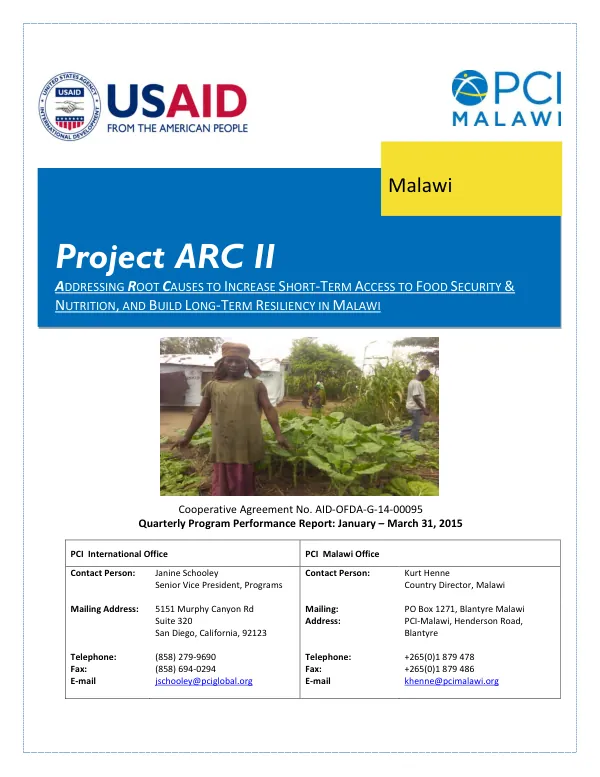
Quarterly Program Performance Report: April – June 30, 2015
Project ARC II is a project implemented by Project Concern International (PCI) in Malawi to increase short-term access to food security and nutrition and build long-term resiliency in the country.
2015 · 15 pages
Sign in to readA free account is required to download.
Abstract
The project is funded by the United States Agency for International Development (USAID) Office of Foreign Disaster Assistance (OFDA) and runs from May 15, 2014 to November 14, 2015. The project aims to reinforce coping mechanisms and resiliency for households affected by drought and armyworm in Balaka and Machinga Districts. The project has three programmatic objectives: to increase household agricultural productivity and access to food through conservation agriculture and home gardens, to reinforce resiliency through expansion and support of village savings and loans program, and to strengthen early detection and community-based management of acute malnutrition. The project targets 4,500 households for agricultural productivity, 6,500 households for resiliency, and 4,000 households for acute malnutrition management. Under Strategic Objective 1, PCI trained 433 beneficiaries in integrated pest management, representing 80% of the quarter's target. Cumulatively, PCI has trained 543 farmers, representing 84% of the life of project target. PCI also trained 326 farmers in disaster risk reduction, representing 185% of the quarter's target. Under Strategic Objective 2, PCI conducted 239 community sensitization meetings to encourage communities to join Women Empowered/Village Savings and Loan (WE/VSL) groups. Following these meetings, 135 WE/VSL groups were formed with a membership of 2,830, representing 121% of the quarter's target. The WE/VSL groups have contributed US $37,846 in savings and loaned out US $44,557, representing a 110% increase in savings from the previous quarter. Under Strategic Objective 3, PCI trained 385 village health committee members in community management of acute malnutrition, representing 71% of the quarter's target. The trained VHC members are now training communities in CMAM, community complementary feeding and learning sessions, and cooking demonstrations as strategies to reduce under-nutrition. Apart from such trainings, VHC members are also conducting growth monitoring and promotion sessions and referring cases of malnutrition to clinics. PCI also conducted 160 community sensitization meetings to encourage communities to start preparing their land using principles of conservation agriculture. Following these meetings, 177 households established backyard gardens, in which they have planted Amaranthus, local rape, pumpkin leaves, and other local vegetables. PCI conducted 54 trainings on the promotion of conservation agriculture principles, which 897 farmers attended. As a result of these trainings, all 897 farmers are currently practicing intercropping. The project has also conducted a barrier analysis to understand how to carry out more effective behavior change strategies for conservation agriculture practices. The results of the survey showed that respondents who adopted mulching and minimum soil tillage faced several barriers, including lack of knowledge, lack of access to inputs, and lack of support from extension services. Overall, the project has made significant progress in achieving its objectives, with a total of 5,432 beneficiaries targeted for agricultural productivity, 343 WE/VSL groups formed with a membership of 6,803, and 385 VHC members trained in CMAM. The project plans to continue its activities in the next quarter, including phasing down support to the communities and identifying key strategies to accomplish this.