GOVERNMENT OF MALAWI
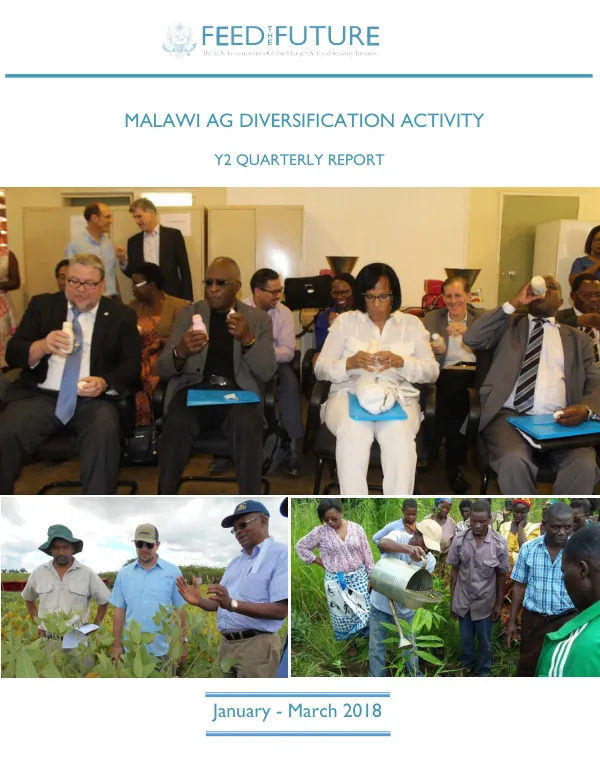
Malawi AG Diversification Activity Y2 Quarterly Report January - March 2018
The Feed the Future Malawi Ag Diversification Activity contributes to USAID/Malawi's Feed the Future goal of sustainably reducing poverty and stunting in eight districts of Central and Southern Malawi.
2018 · 41 pages
Sign in to readA free account is required to download.
Abstract
The Activity seeks to increase the competitiveness of high-value, nutrient-rich value chains through support for agricultural enterprises, and increased access to markets and finance. It also aims to foster inclusive and sustainable growth of Malawi's agricultural sector, and improve the nutritional status of women and children under five through a proven nutrition-sensitive approach of layering agriculture and nutrition behavior change interventions in rural communities. The agricultural sector in Malawi is diversifying away from tobacco as the main cash crop due to anti-smoking sentiments. Attention is shifting to legumes like soybean and groundnuts, crops with high potential for export market growth. However, the soy varieties currently in use in Malawi are low yielding and of low oil and protein content, making the sector less competitive. The same applies to the groundnuts value chain, where current varieties are short of the qualities that buyers and processors are looking for. Through its strategic partnership with the USAID Soybean Innovation Lab, AgDiv is focusing on the introduction of commercially available and market demanded soybean varieties onto the Malawian market. A Pan-African Variety Trial was conducted, testing the adaptability of 36 varieties at nine locations across Malawi. Four of the sites are located at the Department of Agricultural Research Services' stations, and five sites are located on private commercial farms. Varieties are being evaluated for growth, disease resistance, yield, post-harvest performance, and oil and protein content. The identified high-performing varieties can be taken up by the commercial farming sector for production upon official national registration of the variety. AgDiv and its collaborative partners organized a field day on 26th and 27th of March to show the performance of the different varieties in various locations. During the same quarter, AgDiv convened a meeting for USAID-funded projects with interest in the seed sector to discuss the seed roadmap, which it developed to galvanize stakeholders in the seed sector to coordinate, rationalize, and focus development efforts in the seed sector resources for optimal impact. Apart from the seed trials, AgDiv continued to provide support to smallholder farmers in its zone of influence, strengthening their productivity and resilience to the effects of climate change, as well as supporting access to diverse and nutritious foods and empowering women and youth. Through Outcome 2, AgDiv carried out activities aimed at promoting bamboo production to strengthen resilience in select farmers' communities. The bamboo species Dendrocalamus Asper is fast growing, meaning it can be harvested within 3 years, and fully matures in six years. The bamboo can be used to create buffer zones around wetlands commonly known as dambos and can substitute natural trees as a windbreak. Additionally, the bamboo can be used as a renewable source of fuel wood. Through Outcome 3, AgDiv worked with farmer cooperatives to promote dietary diversification and consumption of nutritious foods by distributing OFSP vines to beneficiaries. Domestic cultivation of OFSP provides a critical source of Vitamin A for local communities.
Related documents