MINISTRY OF HEALTH
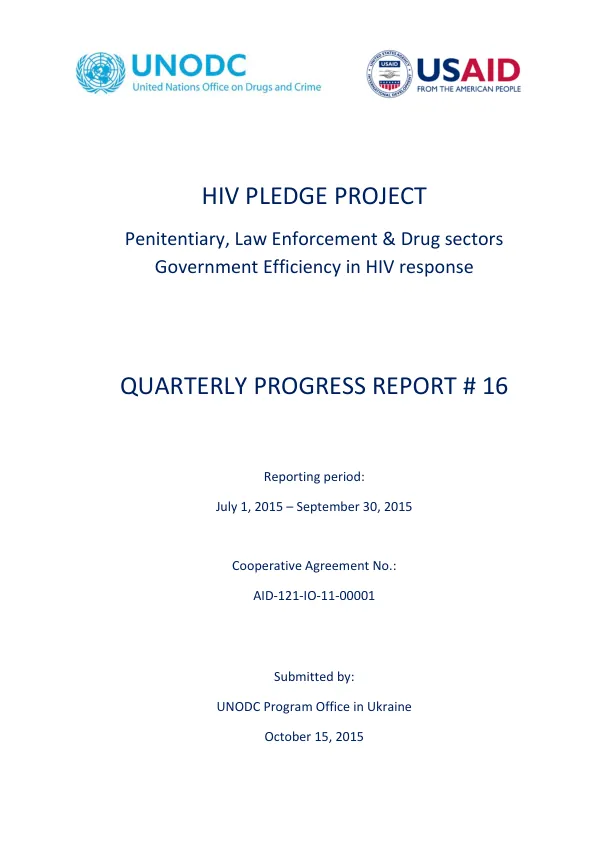
Quarterly Progress Report # 16: HIV PLEDGE Project
The HIV PLEDGE project in Ukraine aims to reduce HIV transmission among most-at-risk populations through increased access to state-of-the-art HIV, AIDS, and drug abuse services.
2015 · 15 pages
Sign in to readA free account is required to download.
Abstract
The project is implemented by the UNODC Programme Office in Ukraine in partnership with the Ministry of Health, Ministry of Justice, Ministry of Interior, and other stakeholders. The project is funded by USAID/Ukraine and builds on the existing work of the UNODC's regional programme XCEA01. The project focuses on three main objectives: creating an environment supportive of evidence-informed and human-rights based HIV/AIDS and drug dependence treatment programs among most-at-risk populations; strengthening the capacity of the State Penitentiary Service, public health, and social services to provide comprehensive HIV prevention, treatment, and care services; and improving the capacity of the drug dependence treatment system to provide integrated HIV prevention and drug treatment services. During the reporting period of July 1, 2015, to September 30, 2015, the project achieved several key outputs. The KAPB survey conducted among police officers and students of police training institutions showed that relevant stakeholders have knowledge and capacity to support the development of comprehensive HIV programs for people who use drugs. The project published a report on the survey, which was agreed with the Ministry of Internal Affairs and published in 500 copies. The project also developed a Law Enforcement Action Plan supporting the implementation of the National HIV program for 2014-2018. The plan was approved by the Ministry of Internal Affairs in August 2015 and outlines areas for further implementation in 2016-2018, including ensuring active participation of law enforcement sector in HIV-related work groups and developing normative legal acts regulating cross-sectoral coordination of HIV prevention and treatment activities. In addition, the project developed and published a handbook for medical personnel of the OST programs on legal and regulatory issues related to the management of controlled substances for medical purposes. The handbook covers issues related to organizational aspects of methadone and buprenorphine usage for OST, legal aspects of OST medicines turnover, and personal data security. The project also piloted cooperative mechanisms between law enforcement, drug control, public health, and civil society partners in selected regions to increase the effectiveness of HIV response at the local level. The project trained over 15 regional CSOs on how to establish and maintain effective partnerships with law enforcement bodies in the context of provision of harm reduction services. The project also finalized and published a training workshop guide and a case study publication on good practices and models of cooperation between law enforcement bodies and HIV-related services providers. The project launched regional pilot projects in August 2015 within the framework of the Grant Programme "Enhancing the role of police in response to HIV/AIDS among PWID in Ukraine." The contracts were signed with three NGOs, and the preparatory work was conducted in all pilot regions to launch referral schemes for police to refer PWID to HIV prevention and treatment services. Overall, the project made significant progress in achieving its objectives and outputs during the reporting period. The project's efforts to create an environment supportive of evidence-informed and human-rights based HIV/AIDS and drug dependence treatment programs among most-at-risk populations, strengthen the capacity of the State Penitentiary Service, public health, and social services, and improve the capacity of the drug dependence treatment system are expected to contribute to reducing HIV transmission among most-at-risk populations in Ukraine.
Related documents