USAID DEC
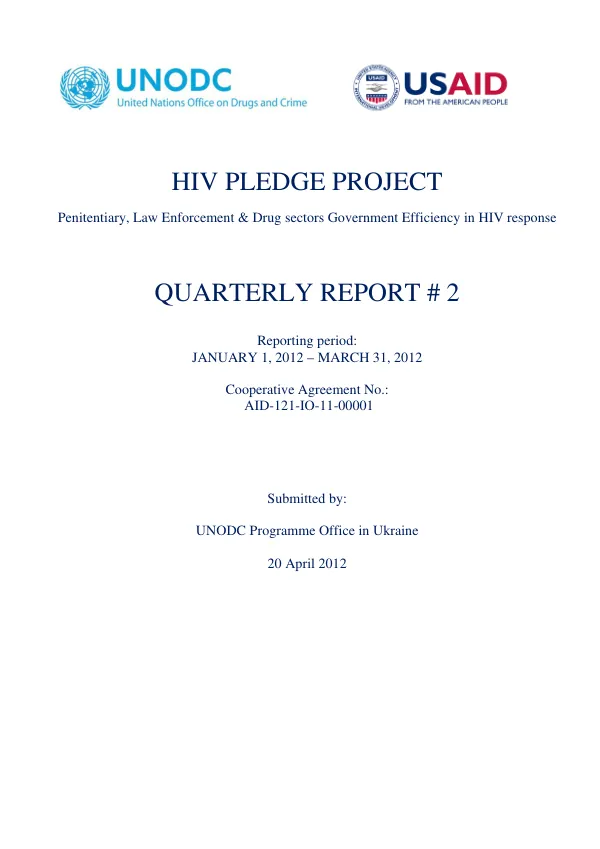
Quarterly Report # 2: Penitentiary, Law Enforcement & Drug sectors Government Efficiency in HIV response
Sign inMINISTRY OF HEALTH
Quarterly Report # 2: Penitentiary, Law Enforcement & Drug sectors Government Efficiency in HIV response
The HIV PLEDGE project is a cooperative agreement between the UNODC Programme Office in Ukraine and USAID/Ukraine to reduce HIV transmission among most-at-risk populations (MARPs) in Ukraine.
2012 · 9 pages
Sign in to readA free account is required to download.
Abstract
The project aims to increase access to state-of-the-art HIV, AIDS, and drug abuse services, including service delivery within pre-, in-, and post-detention settings. This will be achieved through advocacy and policy activities, strengthening the capacity of narcological services to integrate HIV/AIDS and substance abuse services, and expanding HIV, AIDS, and drug dependence treatment services in detention and post-release settings. The project will work with national stakeholders and other donors to ensure cohesiveness with US-Ukraine Partnership Framework goals. Partners include the Ministries of Health, Justice, and Interior, as well as State Services of Ukraine on Drug Control and on countering HIV and AIDS. The programme complements and adds value to existing and forthcoming HIV/AIDS initiatives, including those supported by the Global Fund and the United States Government (USG). The project builds upon achievements and lessons learned from current HIV/AIDS interventions. The goal of the project is to build support among Ukrainian law enforcement officials and other key Government stakeholders for HIV/AIDS and drug dependence treatment services targeted at MARPs, including service delivery within pre-, in-, and post-detention settings. The project has several objectives, including creating an environment supportive of evidence-informed and human-rights based HIV/AIDS and drug dependence treatment programmes among MARPs. To achieve this objective, the project has several outputs, including increased awareness and knowledge of key Government stakeholders on the importance of the accessibility of comprehensive HIV prevention, treatment, care, and support programmes for people who use drugs. A technical working group has been set up and trained on HIV strategic programming, result-based, and human rights-focused planning to develop sectoral HIV policy frameworks, strategic, and operational plans in line with international guidelines and best practices in addressing HIV epidemics among MARPs. The project team has also been in contact with the police coordinators of the Law Enforcement and HIV Network (LEAHN) and public health experts from the Law Enforcement and Public Health programme of the Nossal Institute for Global Health for their participation and contribution to the national round table meeting in Kyiv. The project team has developed a concept note on a KABP (knowledge-attitude-behaviour-practice) survey among law enforcement officials and personnel to gain baseline information about current knowledge, attitude, and practice of police officers related to HIV, PLWH, and MARPs. The KABP survey aims to assess knowledge of HIV among police officers, define attitudes of police toward HIV/AIDS, MARPs, PLWH, level of stigma and discrimination, explore any linkage between knowledge of HIV/AIDS and attitudes towards MARPs, and analyse awareness on risk of contracting HIV at performing professional duties. The target groups for the KABP survey include front-line service, State Automobile Inspection, Department on combating illicit drugs trafficking, and other departments of the Ministry of Interior. The project has made significant progress in the reporting period, including the development of a concept note on the KABP survey and consultations with the National Academy of Internal Affairs and State Scientific and Research Institute of the Ministry of Interior for their possible involvement in the implementation of the survey. The project team has also been in contact with the police coordinators of LEAHN and public health experts from the Law Enforcement and Public Health programme of the Nossal Institute for Global Health for their participation and contribution to the national round table meeting in Kyiv. Overall, the HIV PLEDGE project is making significant progress in reducing HIV transmission among MARPs in Ukraine through increased access to state-of-the-art HIV, AIDS, and drug abuse services, including service delivery within pre-, in-, and post-detention settings. The project's objectives, outputs, and activities are aligned with the US-Ukraine Partnership Framework goals and complement existing and forthcoming HIV/AIDS initiatives.
Related documents